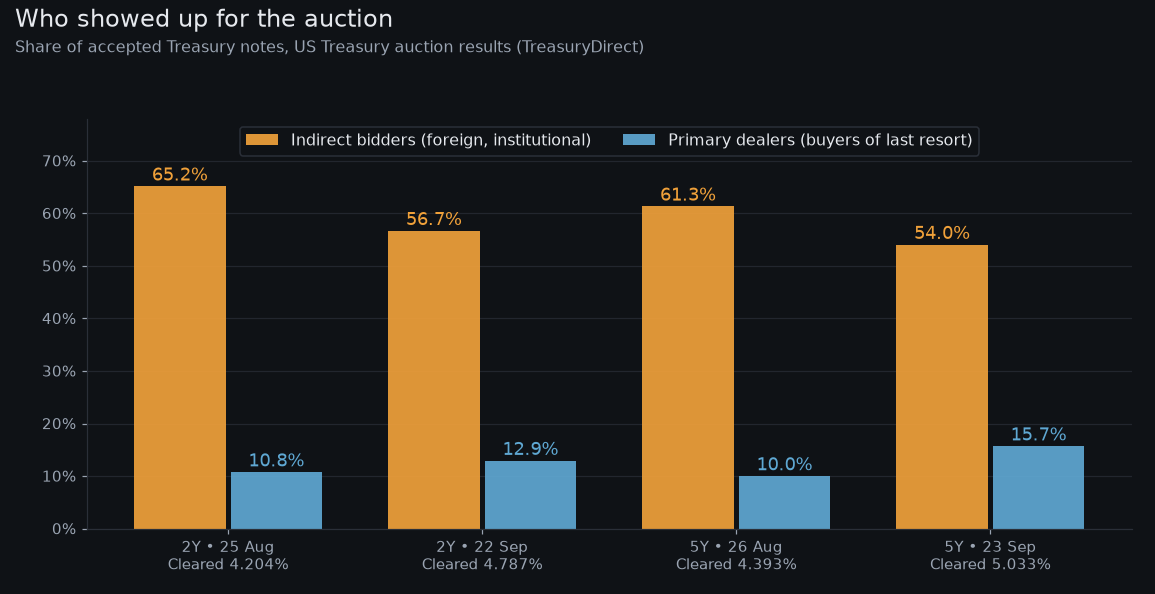
The US Treasury sold $70 billion of five-year notes at 5.033%, 64 basis points above August. Indirect bidders took 54% instead of 61%; primary dealers absorbed 15.7%. A failed price, not a failed payment - and the only asset in the room with no auction to fail.
24 Sep 2026978 words · 4 minAlso on Nostr as a long-form note
On Wednesday the US Treasury sold $70 billion of five-year notes. It got the money, which is not the same as getting a price. The auction cleared at 5.033%, against 4.393% at the previous five-year sale on August 26, a 64 basis point repricing of a single maturity in four weeks, and a coupon of 5.00% on the new issue.
The headline yield is the boring part. What happened underneath is the part worth reading twice.
Bid-to-cover fell to 2.21 from 2.37. Indirect bidders — the category that captures foreign central banks, sovereign funds and the large institutional accounts — took 54.1% of the offering, down from 61.3% a month earlier. When they step back, the difference has to land on somebody, and the somebody is contractually determined: primary dealers, required by their arrangement with the New York Fed to bid at every auction. They ended up with $10.99 billion, or 15.7% of the issue, against 10.0% in August.
Here is the number that says the most. The dealers tendered $85.9 billion, or 1.23 times the entire offering, and were allocated less than 13% of what they bid for. A dealer does not bid 123% of an auction because it is hungry. It bids the size a buyer needs to bid when it is covering the possibility that nobody else shows up. The same auction's bid stack was wide: the median accepted yield was 4.95%, the highest accepted was 5.033%, an 8.3 basis point spread between the middle of the book and its top.
Now put the whole curve next to it. As of Thursday morning, the two-year trade at 4.79%, the ten-year at 5.11%, the thirty-year at 5.41%. That ordering matters more than the level. A curve that steepens from the long end is not a market pricing recession. It is a market demanding to be paid more to hold duration, which is another way of saying it is pricing supply and term premium rather than growth.
The context is not subtle. Six days earlier the Federal Reserve raised its target band to 3.75–4.00%. The longest bond in the market now yields 141 basis points above the ceiling on overnight money. For most of the past fifteen years that relationship ran the other way, with the long end pinned below policy because the expectation was that policy would come down. The expectation now runs the opposite direction, and Wednesday's auction is one data point in a market that has already decided the next move on the long end is up.
Marty Bent, writing in TFTC the same day, made the distinction that most of the auction commentary missed. A failed auction has no prerequisite of a failed payment. The United States issues the currency it borrows in; there is no arithmetic forcing a default. What is being repriced is not solvency but the terms, and the terms are paid by whoever has to roll old debt at the new price. He is right about that, and the Howard Marks memo he leans on makes the same case from the other side: Marks argues the fear of inflation that followed the 2008 rescue never arrived, the world still wants dollar assets, and Treasury buybacks that raise the size of long-dated operations are a mechanical liquidity tool, not a rescue. Buybacks do not cancel a spending commitment. They rearrange when the bill arrives.
The steel-man deserves to be stated properly, because the bearish reading of a single auction is a crowded genre. One tail is one tail. Indirects still took more than half the sale, which is not an evacuation. A five percent five-year note is a genuinely attractive yield for an institution with liabilities in dollars, and higher yields tend to create their own demand. If the seven-year sale on Thursday clears with a tail inside a basis point, bid-to-cover above 2.4 and indirects back above 60%, Wednesday reads as a liquidity air pocket in a week with a Hormuz supply shock and Japan's own debt problem competing for the same buyers. The falsifiable version of the structural claim is exactly that test, and it arrives today.
What cannot be settled from here is whether Wednesday was noise or a regime. What can be said is narrower and still interesting: the buyers who used to absorb size without negotiating have started negotiating, and the only participants absorbing the remainder are the ones legally obliged to.
Which brings the week's other story into the same frame, because it usually gets told separately. Bitcoin rallied more than 50% off its low near $58,000, cleared the May high at $83,000 and traded to $87,000 intraday before pulling back to roughly $84,400 on Thursday morning. James Check's framing in his piece is the useful one: the entire return of a bull market arrives in a handful of days, and the work is being positioned when they come rather than explaining them afterwards. That is true, and it is also unfalsifiable in real time, since the same distribution describes bear market rallies. It should be held as a description of volatility, not a promise about direction.
The two stories connect at the refinancing calendar. If the binding problem is supply, the assets that suffer first are the ones that cannot avoid returning to the market to ask for a new price on old debt: sovereigns, levered corporates, anything with a maturity wall and a coupon to reset. Bitcoin's pitch was never that it rises when liquidity arrives. It is that it has no auction to fail. Nothing about it needs to clear at a price buyers will accept, because there is no auction, no coupon and no roll.
That is a strange thing for a speculative asset to be, and it is the only part of the week that was new.