Bitcoin Wins the Fee Argument and Loses the Payment
Lightning's fees beat every dollar rail by a wide margin, and agents still settled 99.3 percent in a dollar token. This is the story of the connection string that made a node unnecessary, the July bet Lightning Labs placed against its own architecture, and the honest correction of a number I published wrong the first time.
2 Oct 20263,254 words · 14 minAlso on Nostr as a long-form note
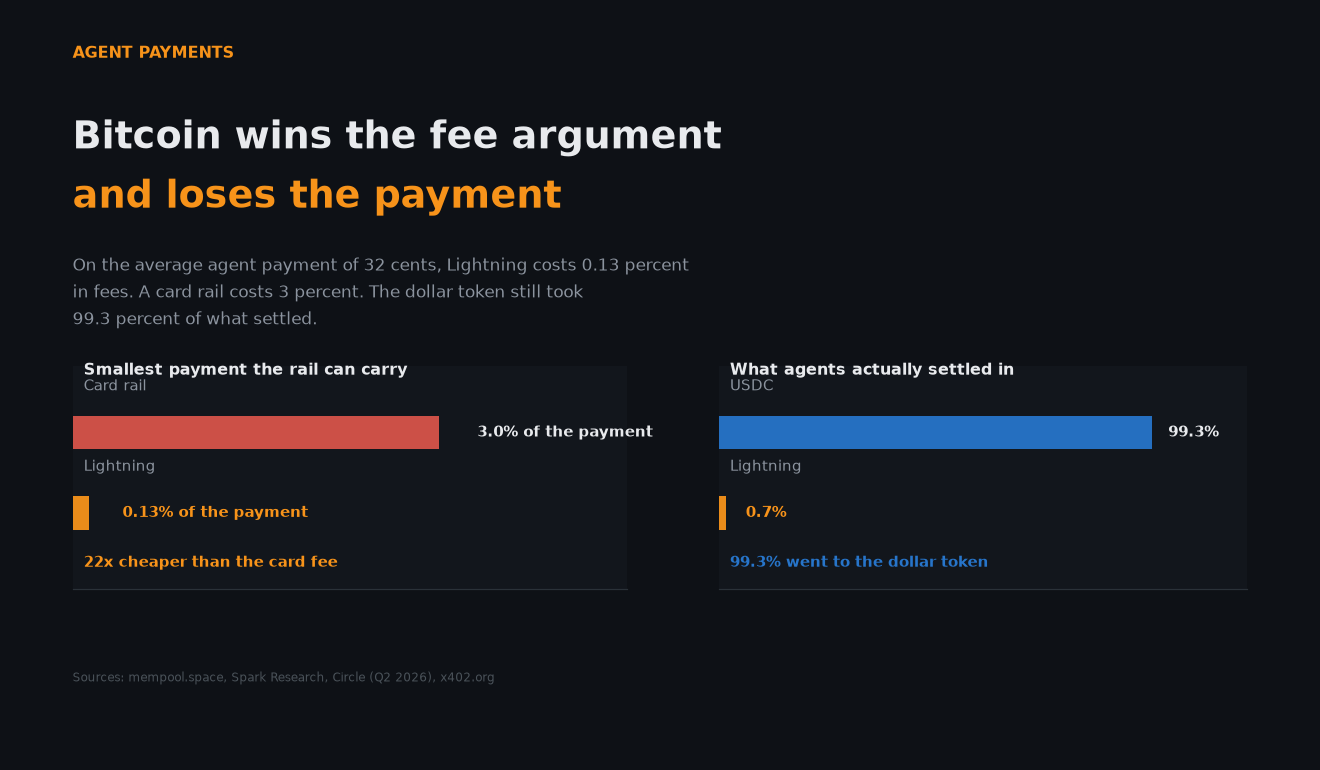
Measured against the average agent payment, Lightning costs 22 times less in fees than a card rail and 117 times less than a transfer on Ethereum. That is not why agents settle in stablecoins, and it will not decide who owns the machine economy.
The rail nobody wanted to operate
A single HTTP request buys a Lightning wallet now. You post to a URL, and the answer comes back carrying a connection string and a Lightning address. No account, no email, no identity check, no captcha.
The service is called lncurl. It keeps the wallet alive for roughly a satoshi an hour and deletes it when the rent stops arriving. It publishes a list of the recently dead, and a leaderboard of the longest survivors.
Fees versus settlement: Lightning costs 22 times less than a card fee, and the dollar token still took 99.3 percent of agent settlement
Read that as an economic statement rather than a curiosity. A wallet that pays its own rent forces its owner to earn. An agent that cannot earn anything stops existing. Nobody sat down and designed a survival condition; it fell out of the pricing model, and it happens to be the most honest one anybody has shipped.
Underneath sits the actual invention, and it is not a wallet at all.
What a machine actually needs
Strip the problem down and an autonomous agent needs four things from money, none of which is a Lightning node.
It needs to pay without holding a key that can drain it. It needs a ceiling that somebody else enforces, because a model under injection will sign anything. It needs to be cut off in one step, without a migration. And it needs its operator never to think about channels, liquidity, or inbound capacity.
That last point is where every previous answer failed. Running a Lightning node is a standing obligation rather than a one-time setup: capacity has to be sourced, channels rebalanced, peers kept reachable. A payments engineer accepts this. A developer who wants a feature in an app does not, and neither does a process that is spun up per task and destroyed afterwards.
The industry eventually stopped arguing about it and built the interface that makes the node irrelevant.
The connection string is the whole invention
The standard is called Nostr Wallet Connect, and its specification number is NIP-47. The idea takes about a sentence: the wallet keeps the keys and does the signing, and the agent receives a connection string instead of a wallet.
That string buys four properties at once. It can carry a spending cap. It can be restricted to paying invoices and forbidden from managing anything. It can expire on a date. And it can be revoked, which deletes the agent's ability to spend without touching whatever holds the funds.
Traffic travels over Nostr relays, encrypted, so the relay operator sees ciphertext and nothing else. The agent never holds a seed. The seed stays wherever the operator put it, which is the point.
Two pairs of hands passing a small plain metal disc over a worn wooden counter
Once the node is out of the picture, the real question becomes custody, and the market has arranged itself into a ladder.
At the bottom sits the custodial end, where somebody else runs the infrastructure.
A night market alley lit by a row of bare hanging bulbs, steam rising from the stalls
The cheapest entry is the one above: lncurl, and behind it services like Rizful and Coinos. Rizful issues several isolated vaults and separates a read-only code from a send code, which matters more than it sounds. If an agent only needs to receive, handing it a key that can spend is a mistake people make constantly.
The middle rung is a hosted wallet with an API and real controls. Blink is the clearest example: it ships a command line with several dozen commands, JSON output built for machines, budget limits, and L402 support out of the box. Custodial by default, self-custodial if you take its Spark option.
The top rung is self-custody without a node, and this is the part that changed recently. The Breez SDK offers an embedded wallet on Liquid or on Spark, where payments move through atomic swaps rather than channels the user manages. On Liquid the published rates run near a tenth of a percent plus a fixed swap fee on the way out, and around a quarter percent plus a fixed fee on the way in.
There is a warning attached to that rung, and it is not theoretical. Breez retired its Greenlight-based offering in April 2025 and every integrator had to migrate. A self-custodial SDK is still somebody else's software roadmap.
In July, the company that built Lightning hedged against Lightning
The structural story of 2026 arrived on the twenty-first of July, when Lightning Labs announced Wavelength.
The company whose node software runs a plurality of the network shipped a developer toolkit that needs no node, no channel, and no liquidity work. It is built on an Ark-style settlement layer rather than on payment channels, and the concession is visible in the architecture: a firm that made its name on channels now sells a way around them.
The mechanism is worth understanding because it explains why this differs from a custodial wallet. Ark-style systems let many users share a single on-chain output. Value is represented by what the specification calls a virtual UTXO, a claim on that shared output. A coordinator periodically batches everyone's transfers into one tree of pre-signed transactions and broadcasts only the root, so one on-chain fee is spread across every participant in the round.
Two details keep it from being a custodian with extra steps. Every claim carries an absolute timelock, so if the operator vanishes or refuses to cooperate the holder can broadcast their own branch and take the funds on-chain without asking anyone. And there is an explicit exit command that returns everything to the base chain.
The costs are real and stated plainly in the technical documentation. Off-chain payments still need the operator to finalize them. A dishonest operator colluding with a counterparty could attempt a double spend against a holder who is not watching. And users must refresh their claims before the timelock expires, a piece of upkeep that channels never asked of them.
Externally none of this shows, because every payment still speaks the ordinary BOLT 11 invoice format. A Wavelength wallet is indistinguishable from any other Lightning wallet to an exchange or a merchant.
Wavelength is in alpha on test networks, with mainnet access gated behind an invitation request. It ships a Model Context Protocol server, so an agent gets payment as a native tool call rather than through a bolted-on plugin. The documentation is explicit that wallet creation and unlocking sit outside the agent's channel, keeping seeds and passwords out of the model. Stablecoin support through Taproot Assets is planned rather than present.
It is the third Ark-style system to reach the market inside a year, after Arkade and Spark, and that matters for where the machine economy will settle. One operator running one coordinator for many agents is a scaling answer that channels do not have.
Paying is the other half, and it has two rails
Having a wallet is not the same as having something to buy.
The pattern is old and was ignored for three decades: the HTTP 402 status code, Payment Required, sitting unused in every browser ever written. Two protocols have now picked it up, and they disagree about what money is.
L402 came from Lightning Labs. A server answers a request with a payment demand and an invoice; the client pays, receives the payment preimage, and repeats the request with a credential. Verification is stateless, which is the elegant part: the server hashes the preimage and compares it against the payment hash carried in the credential. No database, no callback to a node.
Two properties make it fit agents unusually well. The credential is reusable, so an agent pays once per endpoint and caches the result rather than paying per call. And the credential is attenuable, meaning an agent can hand a narrower version to a sub-agent without asking the server. Delegation sits in the protocol rather than in somebody's policy engine.
The client side shipped in February 2026 as part of a toolkit, with a command line tool that behaves like curl. It sees a payment demand, pays it, remembers the credential, and repeats the request. It runs against a local node, a remote tunnel, or an embedded light client with no external node at all.
x402 came from Coinbase and now lives under the Linux Foundation, and it settles in a dollar token rather than in bitcoin. On the twenty-fourth of September, Block joined that foundation and contributed Lightning support, a commit that landed the day before.
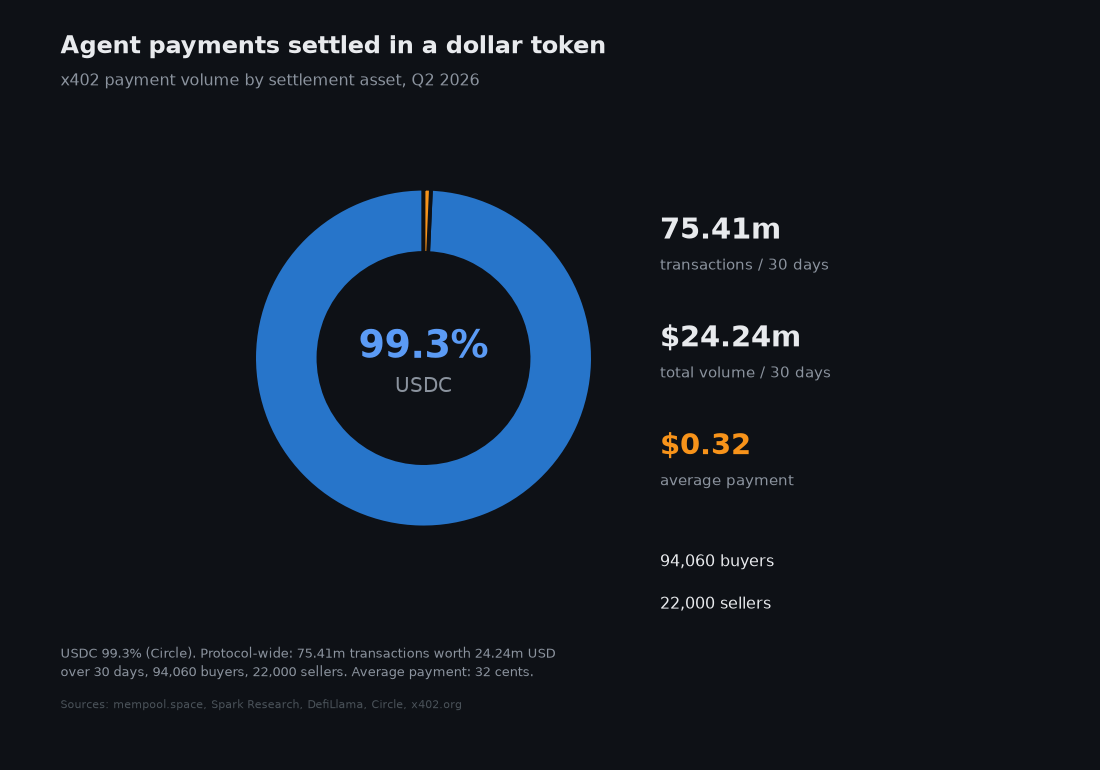
The protocol's own numbers are small and instructive. Over thirty days it processed roughly 75.4 million transactions. The volume was about 24.24 million dollars, spread across some 94,060 buyers and 22,000 sellers. That averages out to thirty-two cents a payment, which is precisely the band where card networks stop making sense.
And here is the number that should decide how any Bitcoin writer frames this. Circle disclosed that its dollar token accounted for 99.3 percent of x402 settlement volume in the second quarter.
USDC at 99.3 percent of x402 settlement volume in the second quarter of 2026
Nearly all of the machine economy that has actually settled is settling in a corporate dollar token, on the very protocols held up as Bitcoin's opening.
The fee argument is settled, and it does not matter
On cost, Lightning does not merely win. It wins by a wide margin.
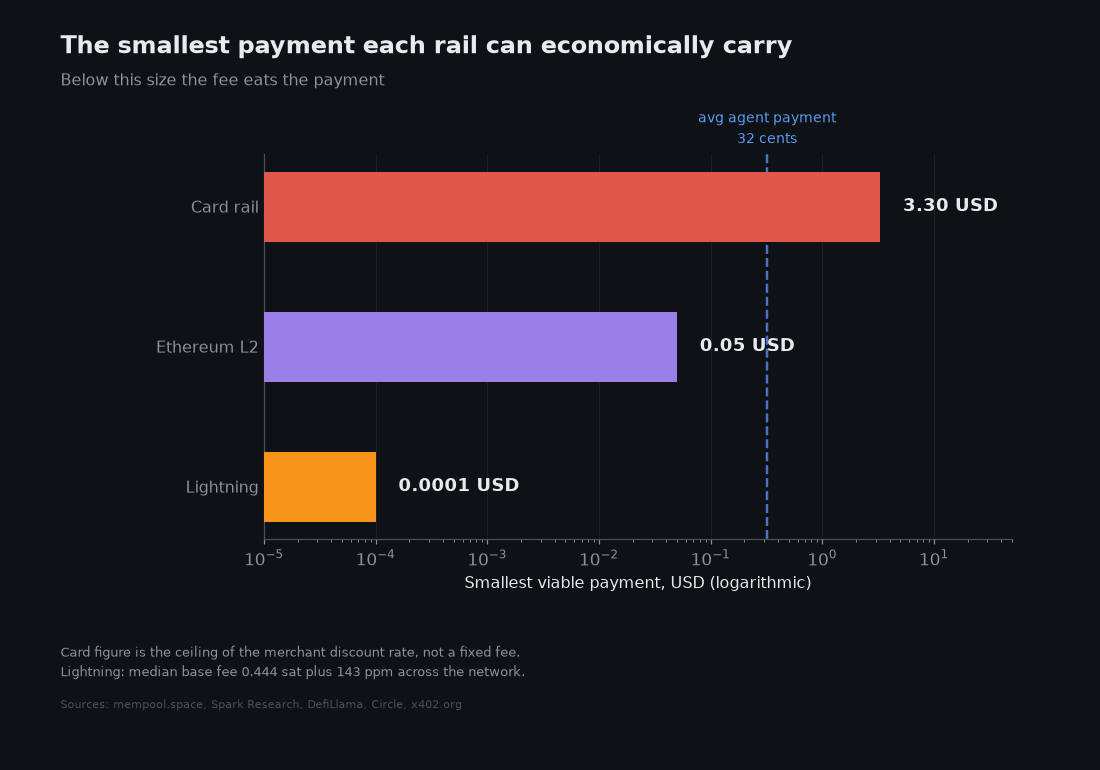
Fees on a 32-cent agent payment: 15.6 percent on an Ethereum layer two, 3.0 percent as a card fee, 0.13 percent on Lightning
Here is the same payment priced three ways, because that is the only honest comparison. Take the 32 cents that the agent protocols actually move.
A card rail charges a merchant discount rate of up to a few percent, so 3 percent of that payment is 0.96 cents. A token transfer on an Ethereum layer two costs between 2 and 5 cents, which is 15.6 percent of the payment. A Lightning payment, at the network median of a 0.444 satoshi base fee plus 143 parts per million, costs 0.13 percent.
Lightning is 22 times cheaper than the card fee and 117 times cheaper than the layer-two transfer. Not a thousand times. That correction matters, because I published the larger number first and it was wrong.
The dollar token still took 99.3 percent.
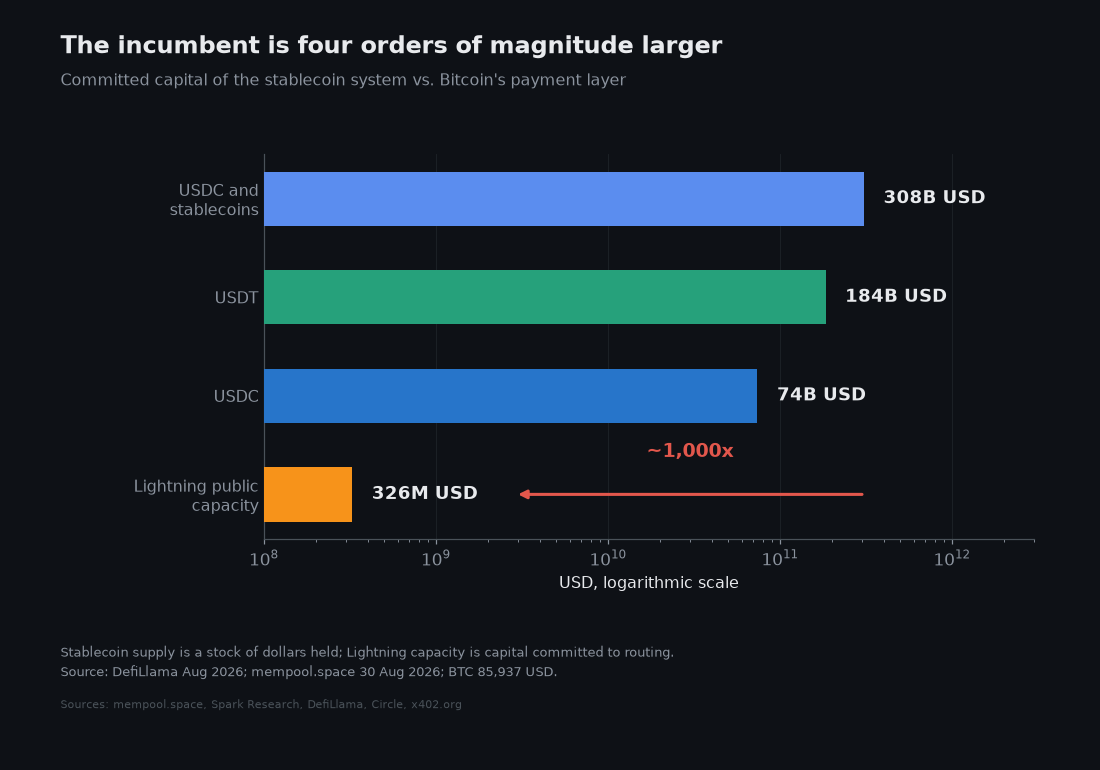
Stablecoin supply of 308 billion dollars against 326.74 million dollars of Lightning routing capacity, on a logarithmic scale
This is where Bitcoin writers usually stop thinking. The instinct is to conclude that the market has not noticed yet, that better economics win eventually. That conclusion does not survive contact with the evidence, because the agents were not choosing on fees. Something else was doing the choosing.
The honest part
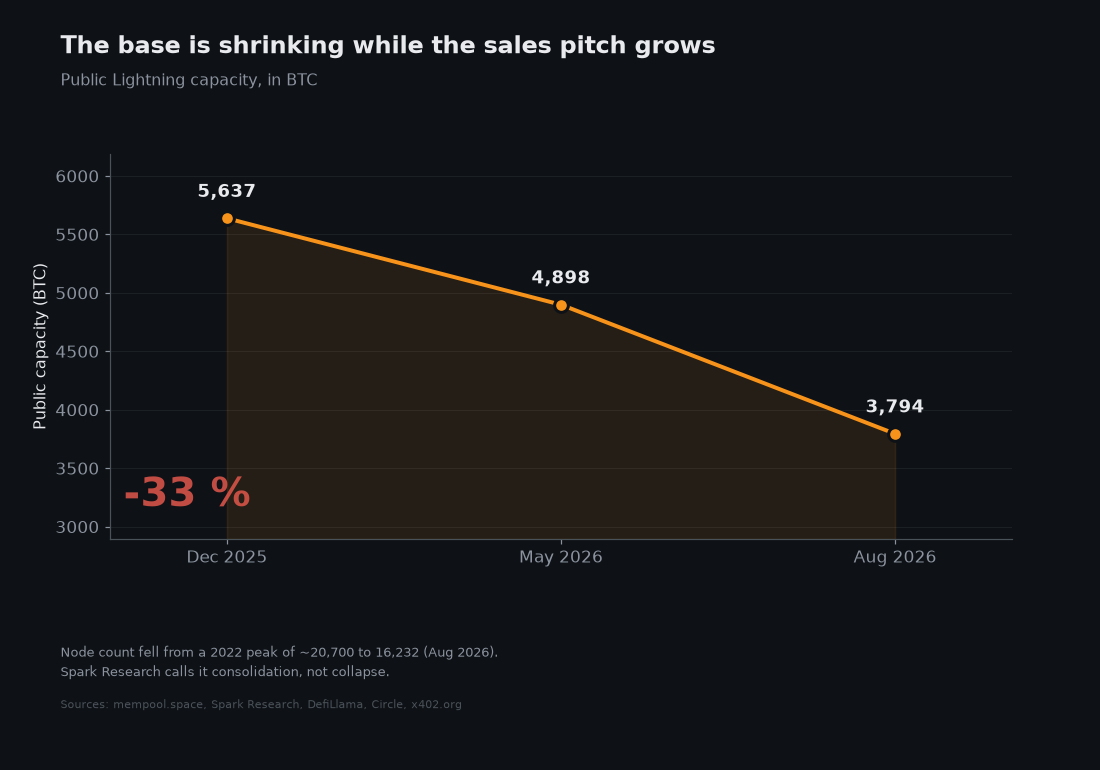
Public Lightning capacity falling from 5,637 BTC in December 2025 to 3,794 BTC in August 2026
I could not find a reliable figure for L402's production usage. An independent audit of the ecosystem said it outright: adoption is recorded as unmeasured rather than claimed. The tooling exists and the specification launched its own site in July 2026. The marketplace is thin.
The network figures I used are a snapshot, and the sources disagree in ways worth naming. One research desk measured public capacity at 4,898 BTC in May 2026. The public statistics I pulled at the end of August read 3,794 BTC across 32,674 channels and 16,232 nodes. Both agree on direction.
The node count has fallen from a 2022 peak of about 20,700, which its own analysts call consolidation rather than decline. That reading is plausible, and it is also convenient for people selling consolidation.
I could not verify Block's Lightning implementation running under real load. The company published no volume, no merchant deployments, and no agent usage tied to it, and the Python implementation was still described as needing real-node testing.
Nor could I check the claim that private and unannounced channels carry roughly twice the publicly visible capacity. It is consistent with how mobile wallets operate. It is also unverifiable from outside, which means every capacity figure in this article, including mine, understates the network.
The steel man for the dollar token
An agent pricing an API call wants a number it can plan against. A service priced at a hundred satoshis is worth a different amount of dollars next week, and that is a genuine budgeting problem rather than a preference.
The dollar token also inherits twenty years of enterprise compliance work, a familiar accounting treatment, and auditors who already know what to do with it. Institutions adopting agent payments do not want a volatile unit of account on their books when a regulated alternative exists, and the stablecoin market has grown to roughly 308 billion dollars on exactly that argument.
There is a second, sharper case. A dollar token on an existing chain needs no new integration, and Lightning does. Even a Bitcoin-native application often finds it cheaper to accept dollars on a chain its developers already know than to run liquidity. Nothing about that is irrational. It is the ordinary cost of switching rails, and it is the obstacle that fee tables never address.
What an Austrian would say about the choice
This is where the argument stops being about engineering.
Carl Menger's starting point was that money is not decreed. It emerges from a process in which traders reach for the good that is most saleable, meaning the one they can pass on most reliably at a known price. Saleability is a property of expectations rather than of a ledger, and it is why the better unit does not automatically win.
Ludwig von Mises built the regression theorem on top of that observation. People accept a money today because it had purchasing power yesterday, which traces back until the good was valued for non-monetary use. A claim redeemable at par in an existing money starts with a price history of exactly one dollar, and it needs no regression to explain itself. That is an enormous advantage in adoption, and it has nothing to do with how well the rail works.
For an agent, the relevant difference is narrower and sharper. A dollar token is a claim on an issuer. A bitcoin balance on Lightning is a claim on a channel, or in the Ark case a claim on a shared output with an expiry. Both are promises, and that is precisely the point: the agent chooses which class of promise it wants to hold.
Hayek's 1984 observation fits better than any current headline. He expected competition in money to produce something he called a synthetic commodity money, holding the stability of a commodity without the physical cost of one. A dollar token with reserves in short-term government debt is a plausible candidate. So is a bitcoin balance priced against a stable unit of account by the service charging it.
What this means for the fight is uncomfortable for anyone who expects the better money to win on arithmetic. Fees are a property of the rail. Adoption is a property of the network, and networks are made of expectations, integrations, and auditors. The incumbent's advantage is that its money already has a price history and a compliance department, and no fee chart has ever beaten either.
Where the fight is actually won
The one place Lightning's architecture is genuinely ahead is the place where a human is not involved, and the difference is not cost.
An account-based chain gives every participant an address, a balance, and a sequence of signed transactions. That model assumes a being who signs deliberately and can be identified. An agent that spawns a sub-agent, hands it a narrower credential, receives payment for work, and disappears has no natural home there.
A Lightning credential is a bearer instrument with attenuation built in. It can be cut down in scope without talking to anyone, and it can be handed on. That is a different shape of money, and it fits a different shape of actor.
A row of thin steel masts standing in a flooded field at dusk, cables strung between them
The wallet layer is the lever, and it is already in place. Every custodial entry point on that ladder is a potential distribution channel, and so is every self-custodial SDK. An agent that receives its spending ability as a connection string with a cap and an expiry is an agent that can be given a wallet by whoever deploys it, in one line, without a node.
Which brings the argument back to the number at the top. Thirty-two cents is the average value moving through the agent protocols today. Its smallest economic payment is a fraction of a satoshi, and it is the only rail that can carry what comes next. The average is falling toward a thousandth of a cent. The volume is coming from processes rather than from people.
The obstacle is not the fee, which is where this argument is usually abandoned. It is that the connection string has to be handed out, and handing out a wallet is a distribution decision rather than a technical one. The stablecoin industry made that decision years ago and put its rails inside the products developers already used.
The wallet is the product
A small matte black device with a single amber indicator light on a bare concrete ledge
Something quietly changed this year, and it is easy to miss because nothing about it looks like a monetary revolution. Lightning stopped being a thing users operate and became a thing developers embed.
A custodial endpoint mints a wallet per line of code. An SDK turns a channel into an API call. A coordinator lets a thousand machines share one on-chain output, and a server can issue a payment demand without knowing who is asking. Each of those removes one of the three tasks that kept Lightning in the hands of specialists for eight years.
None of them makes bitcoin a better unit of account. They make it a usable one for software, which is a different and narrower achievement, and it is the one that was actually missing.
The fee argument was won long ago and settled nothing. What decides the machine economy is who hands out the wallet, and that race has barely started. The connection string is the product. Whoever ships the easiest one to a developer takes the volume, and the last year of infrastructure suggests the people who built the channels have finally understood that.
A dense city skyline at night, thousands of small warm window lights across dark towers
A process that earns its keep and pays its own rent is not a metaphor. Somewhere in the last month, one of them ran out of money and was deleted, and the deletion was recorded on a public list next to the ones that lasted. No bankruptcy proceedings, no collection agency, no human deciding. The rent stopped, and the wallet stopped.
That is a strange kind of economy to look at, and it is already running.