Eighty-eight listed companies now hold 1.26 million bitcoin — six percent of everything that will exist. The dollar has started paying its savers a real return for the first time in years. A monthly letter on what happens when both are true: own data, own charts, Austrian reading.
29 Sep 20262,103 words · 9 minAlso on Nostr as a long-form note
On 16 September the Federal Reserve published its weekly deposit file. It showed 19,568 trillion dollars parked at American commercial banks, about five percent more than a year earlier. That number is not remarkable. What is remarkable is the price those deposits are paid, and who is now borrowing against the difference.
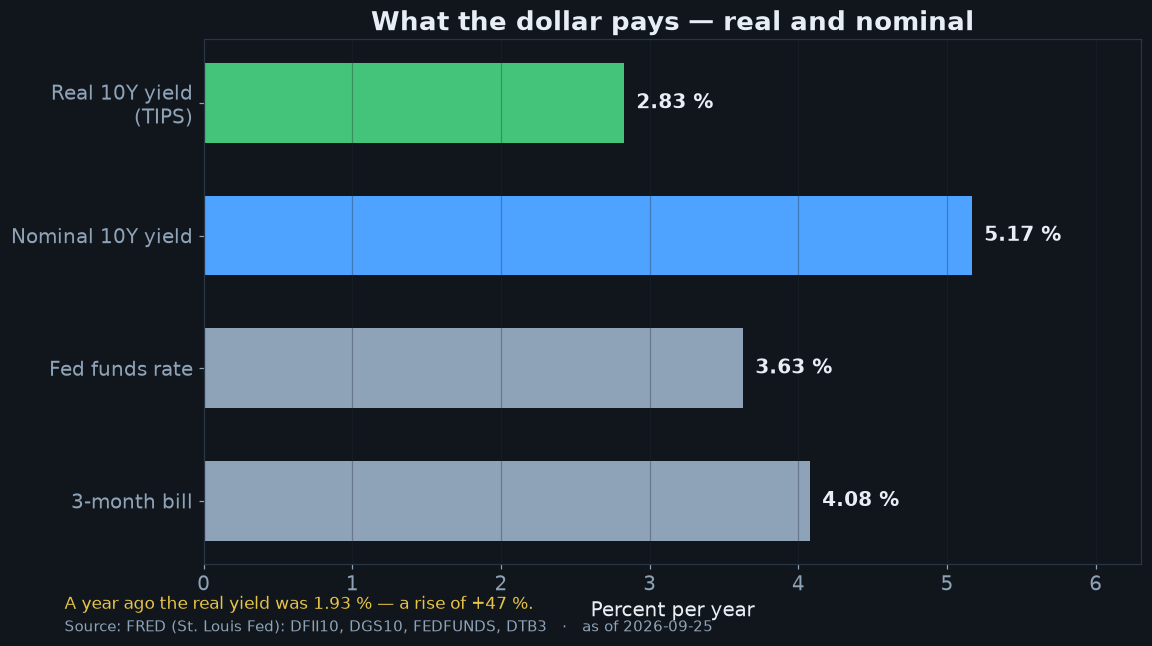
The real yield on a ten-year Treasury — the return after inflation, measured by the TIPS series the Fed publishes every day — closed at 2.83 percent on 25 September. A year ago it was 1.93 percent. For the first time in a long while, holding dollars is not a slow loss. It is a small, certain gain. An economy that pays savers a real return is an economy that no longer needs to be escaped.
And yet 88 publicly traded companies now hold 1,261,294 bitcoin between them, according to the tally at bitcointreasuries.net. That is 6.01 percent of the 21 million coins that will ever exist. Nine of those companies did not exist two years ago in their current form.
This letter is about what happens when the two facts meet.
What the dollar pays, real and nominal. Ten-year TIPS real yield, nominal 10Y, Fed funds and the three-month bill. Own chart, Federal Reserve series DFII10, DGS10, FEDFUNDS and DTB3.
The price of patience
Start with the arithmetic, because the arithmetic is the whole argument.
The three-month Treasury bill paid 4.08 percent on 25 September. The national average checking account, according to the figure Torsten Slok of Apollo uses, pays 0.1 percent. The gap is roughly four percentage points a year, and it has been visible on a screen every morning for three years. Deposits grew anyway. Whatever keeps money in a near-zero account, it is not ignorance of a better offer.
Now add the real yield of 2.83 percent. An American saver can hold a government obligation, collect after inflation, and take no duration risk worth naming. In the language of Vienna, the market is paying people to wait. That is the opposite of the condition that made bitcoin interesting.
So why is the corporate treasury of the listed world still walking into the hard asset?
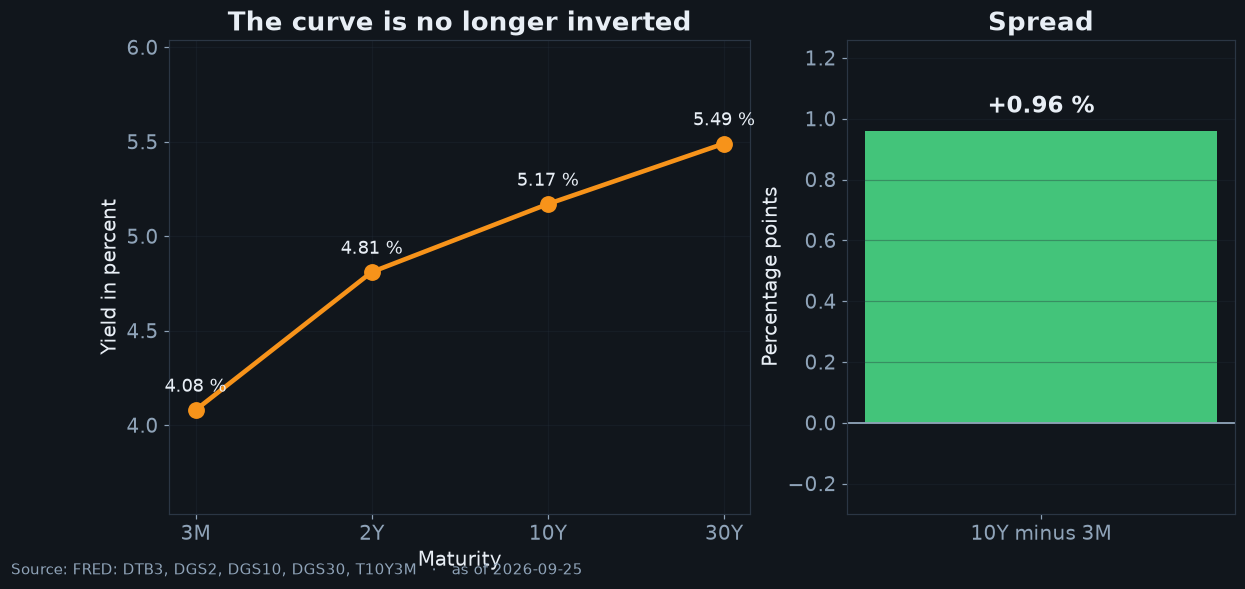
The yield curve, no longer inverted. Three-month, two-year, ten-year and thirty-year yields with the 10Y-minus-3M spread. Own chart, Federal Reserve.
What the treasuries actually bought
Look at the shape of the curve instead of the level. The spread between the ten-year yield and the three-month bill is plus 0.96 percentage points. For most of the last two years it was negative. A positive spread means the market expects short rates to fall, or long rates to rise, or both. The Fed funds rate sits at 3.63 percent. The ten-year sits at 5.17.
A company that borrows at the front of this curve to buy a non-yielding asset has made a specific bet. It is not betting on bitcoin's price. It is betting that the front of the curve falls faster than the asset's carrying cost. That is a duration trade wearing a bitcoin costume, and it is why the model spread faster than any other idea in finance.
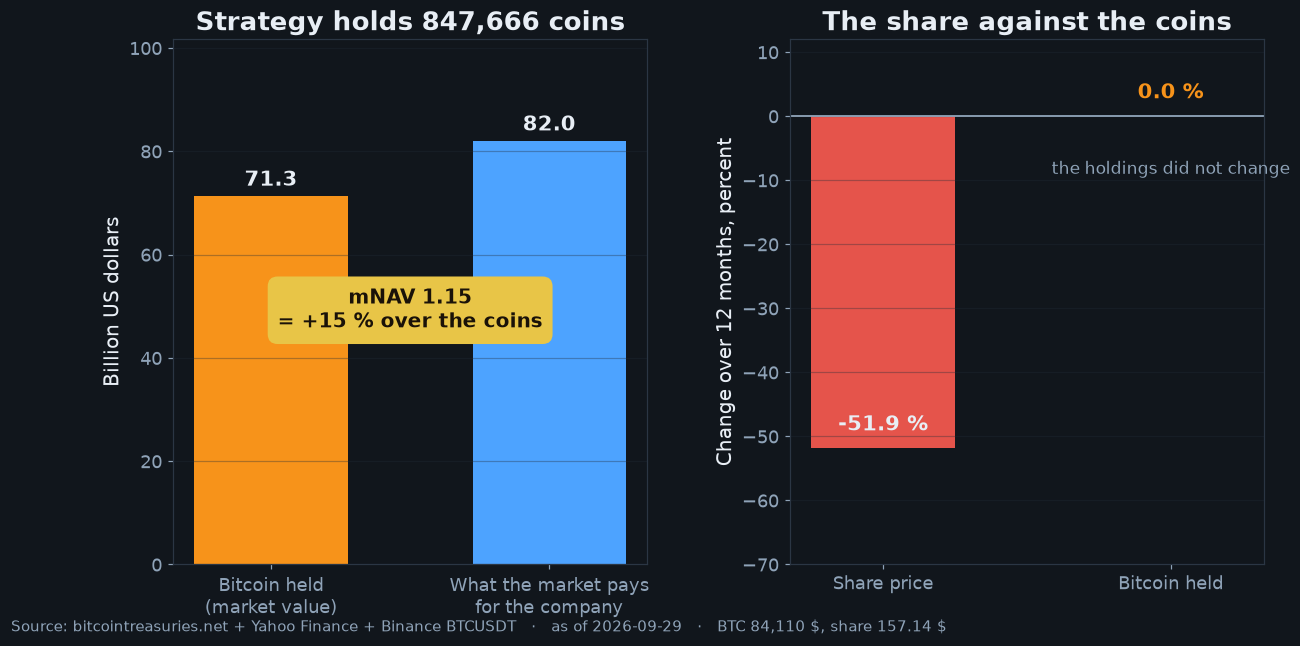
Strategy holds 847,666 bitcoin. At 84,110 dollars a coin that is 71.3 billion dollars of the asset. Its stock trades at 157.14 dollars, down 51.9 percent over twelve months while its holdings did not change by a single coin. The fully diluted premium — what the market pays over the value of the coins, after every convertible and every preferred claim — is 1.15 times. Investors are still paying more than the rock is worth.
Read that combination carefully. The asset held steady. The share lost half its value. The premium survived both.
Strategy: the bitcoin it holds against what the market pays for the equity, plus the twelve-month move in the share against the unchanged holdings. Own chart, bitcointreasuries.net and Yahoo Finance.
The Austrian objection, stated properly
The honest version of the sceptic's case is stronger than the slogan.
If the real yield is positive and rising, the marginal saver has no reason to leave the dollar. Capital should flow back toward the risk-free anchor, not away from it. On this reading, the corporate bitcoin treasury is a late-cycle financing artefact: cheap convertibles, retail enthusiasm, a premium that lets management issue paper and buy coins. When the premium closes, the machine stops. Strategy's own preferred stack — roughly 20 billion dollars of senior claims sitting above the common stock — is the visible version of that risk.
That argument has teeth. A positive real yield is genuinely new after fifteen years, and it genuinely competes with a non-yielding asset.
But it explains the financing, not the demand. And the demand has a different driver, one the rate does not reach.
The number nobody watches
US M2 stood at 23,343 trillion dollars in August, up 4.4 percent from a year earlier. That is roughly 988 billion new dollars in twelve months. The Fed's balance sheet, at 6,748 trillion, has stopped shrinking. Money-market reverse repo balances have collapsed from 110 billion to 0.85 billion — a 99 percent drawdown — which means the spare cash that used to be parked at the Fed overnight has been spent into the system.
Here is the part that matters. Since the start of 2026, M2 has grown 4.15 percent. The consumer price index has grown 2.5 percent over the year. A real yield of 2.83 percent assumes the inflation measure is the right one. For an investor holding a business, a claim on real assets, or a scarce commodity, the relevant comparison is not the CPI. It is the growth of the medium of exchange against the growth of everything else.
Nothing about a positive real yield changes the quantity of claims. It changes their price. An economy can pay savers a real return and still expand the number of units those savers are paid in.
The fragility is in the structure, not the price
The treasury companies are not one idea. They are three, and they fail differently.
Strategy is a financing machine. Its risk is the premium closing while its senior claims remain. The coins do not care, but the equity does.
Metaplanet and Twenty One Capital are smaller versions of the same trade, with less access to cheap paper. Their mNAV values — 0.77 and 0.75 — already trade below the value of their coins. The market has begun to discount the structure, not the asset.
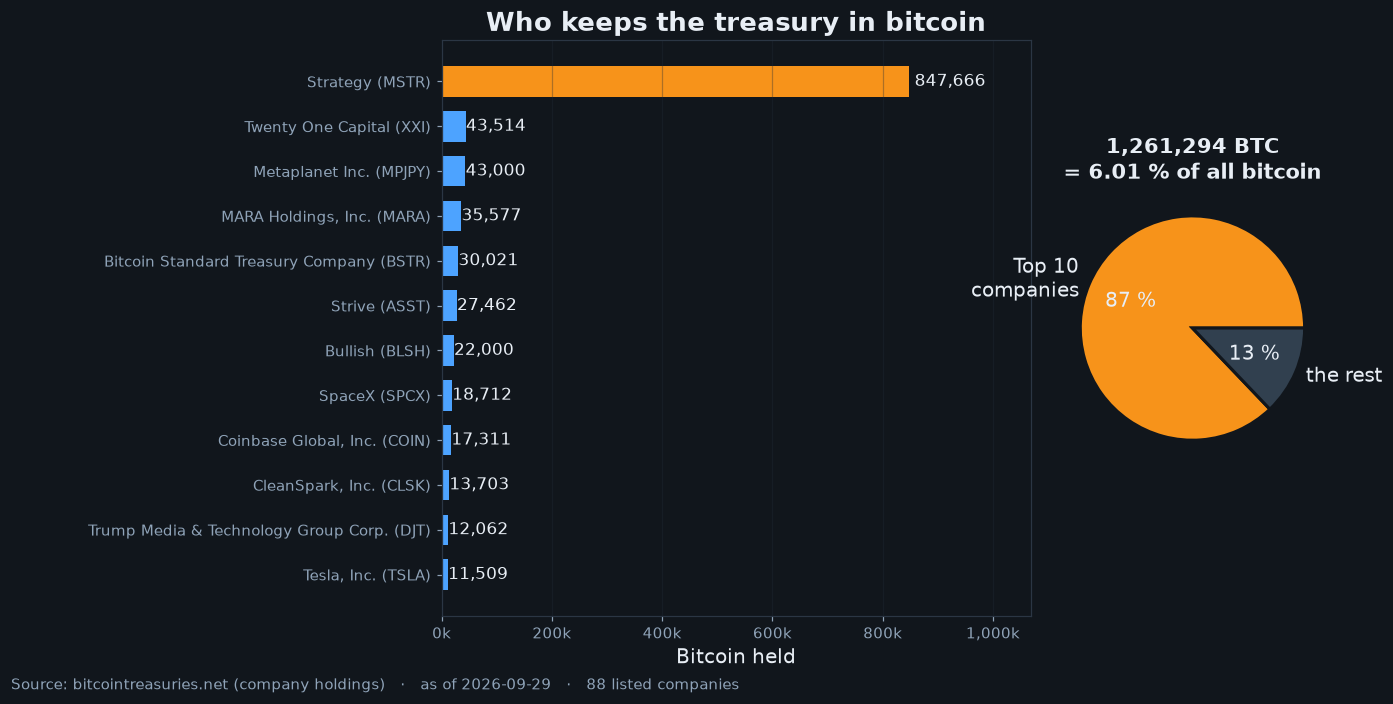
The third group is different, and it is the interesting one. Coinbase holds 17,311 coins because it is a custodian. SpaceX holds 18,712 because it sits on cash it does not need this quarter. Tesla holds 11,509 for the same reason. These are not leveraged bets. They are the ordinary decisions of companies that looked at their balance sheet and concluded that a portion of it should not be denominated in a unit whose supply is a policy variable.
That third group is the one that does not need the premium, the convertibles, or a bull market. It is also the group that grows for reasons no interest rate can reverse.
Who holds the coins. The twelve largest publicly traded bitcoin holders and the share of the total held by the top ten. Own chart, bitcointreasuries.net.
The steel man I cannot dismiss
There is a version of the bear case that I want on the record, because it is the one that would falsify this letter.
If the real yield keeps rising — call it above four percent for a sustained period — the dollar becomes a perfectly adequate savings vehicle for the ordinary holder. Not for a corporate treasury that must outrun the growth of its own cost base, but for the person deciding where next month's surplus goes. In that world the marginal buyer of bitcoin does not arrive. The treasury companies keep their coins and stop adding. The premium closes to one, then below one. Nothing breaks. The asset simply stops being the answer to a question it once answered.
That is a real scenario and it requires no catastrophe. It requires only that the inflation measure used by the bond market stays close to what people actually experience.
Which brings the argument to its real hinge, and it is not bitcoin.
What the rate actually prices
A ten-year Treasury yielding 5.17 percent with inflation at 2.5 gives a real return of 2.67 points. A ten-year TIPS at 2.83 gives a real return of 2.83. The two numbers are supposed to describe the same thing. They differ because the market's inflation expectation — the breakeven — is not the CPI print. It is what bond buyers believe inflation will be.
US gross federal debt stands at 39,065 trillion dollars against a nominal GDP of 32,486 trillion. That is 120 percent of output, and the debt grew 1.4 percent while GDP grew 3.4 percent. For now, output is winning. That is the single most important ratio in this entire letter, and it is the one nobody posts about.
The reason it matters: a state with 120 percent debt-to-output and a positive real yield is a state that pays a real return to its creditors. That is sustainable as long as growth exceeds the interest cost. The moment it does not, the adjustment happens through the unit — and the adjustment does not announce itself in advance.
A company that converts its treasury into a scarce asset is not predicting that moment. It is refusing to need the prediction.
The position I hold
The Austrian reading of this moment is not that bitcoin must rise. It is that the price of money is being administered, that administered prices misallocate capital, and that the capital structure built on top of them is more fragile than its owners believe. Mises put the conclusion plainly: credit expansion does not end in equilibrium, it ends in a reversal.
That does not tell us the date. An agent with a one-year memory would have chosen the Treasury bill over the coin, and would have been right. The mechanism is what is being described here, not the timing.
What can be said with the numbers in front of us is narrower and more useful. The dollar now pays its holders to wait. The waiting is funded by an expansion of the units being paid. And a small but growing group of companies has decided that their balance sheet should hold something whose quantity no committee can vote on.
Those three sentences can all be true at the same time. Most market commentary cannot hold more than one.
What I could not check
Three numbers in this letter are weaker than the rest, and the reader should know which.
The 0.1 percent checking-account average is Torsten Slok's figure. I did not audit it, and the true average differs by institution and by balance.
The 2.83 percent real yield is the ten-year TIPS reading on 25 September 2026. The 2.5 percent inflation figure is the twelve-month change to August 2026. The two are measured over slightly different windows, so the comparison carries that error.
The company holdings come from bitcointreasuries.net, a private tally that compiles public filings. It is the most complete source I can reach, but it is not a primary one. Strategy's own filing is the authoritative number for Strategy.
Everything else in this letter was pulled directly from Federal Reserve series, Binance, or Yahoo Finance on 29 September 2026.
Closing
Watch two things, not the price.
First, the breakeven — the gap between nominal and real yields. If it widens while the real yield stays high, the bond market is telling you it does not believe the inflation prints. That is the signal that the savings argument for dollars is weaker than it looks.
Second, the premium. Watch what Strategy's mNAV does while its holdings sit still. A premium that survives a 52 percent drawdown in the share price is not enthusiasm. But a premium that closes while the coins remain is the beginning of a different story, and the equity holders will feel it long before the asset does.
The interesting question is not whether bitcoin is money. It is whether the firms that already answer yes can survive being right early.
Data in this letter was collected on 29 September 2026 and is reproducible: FRED series DFII10, DGS10, DGS30, DGS2, DTB3, FEDFUNDS, M2SL, CPIAUCSL, GDP, GFDEBTN, WALCL, RRPONTSYD, DPSACBW027SBOG; company holdings from bitcointreasuries.net (same date); prices from Binance and Yahoo Finance.