Kazakhstan's July 2026 decree lets oil producers sell flare gas to bitcoin miners at the wellhead, off the grid. The energy checks out: 1.25 TWh against a global mining band of 150-180 TWh. The same week, a departing SEC commissioner put zero-knowledge identity proofs into the federal record. Two regulators, writing rules for mechanisms they do not operate.
28 Sep 20261,449 words · 6 minAlso on Nostr as a long-form note
Kazakhstan flared somewhere between 300 and 340 million cubic meters of associated petroleum gas in 2024. That is the kind of number that usually appears in a methane inventory and nowhere else. In July 2026 President Kassym-Jomart Tokayev signed a decree that gives it a second life: oil producers may now sell that gas to digital-asset miners at the wellhead, off the grid, at prices the producers set themselves.
"Looking for Change in Haystacks" is a title you would not expect to find in the SEC's speech archive. That was Hester Peirce's farewell address to SIFMA's Digital Assets Conference on 23 September, in her penultimate week as a commissioner, and it attacked the premise of financial surveillance rather than its excesses. Two documents, one from an oil state's legal information system and one from a US federal transcript, describe one shift: both governments have stopped arguing about whether cryptographically native systems should exist, and started writing rules for them.
Four kilowatt-hours nobody wanted
Start with the physics, because everything downstream is arithmetic.
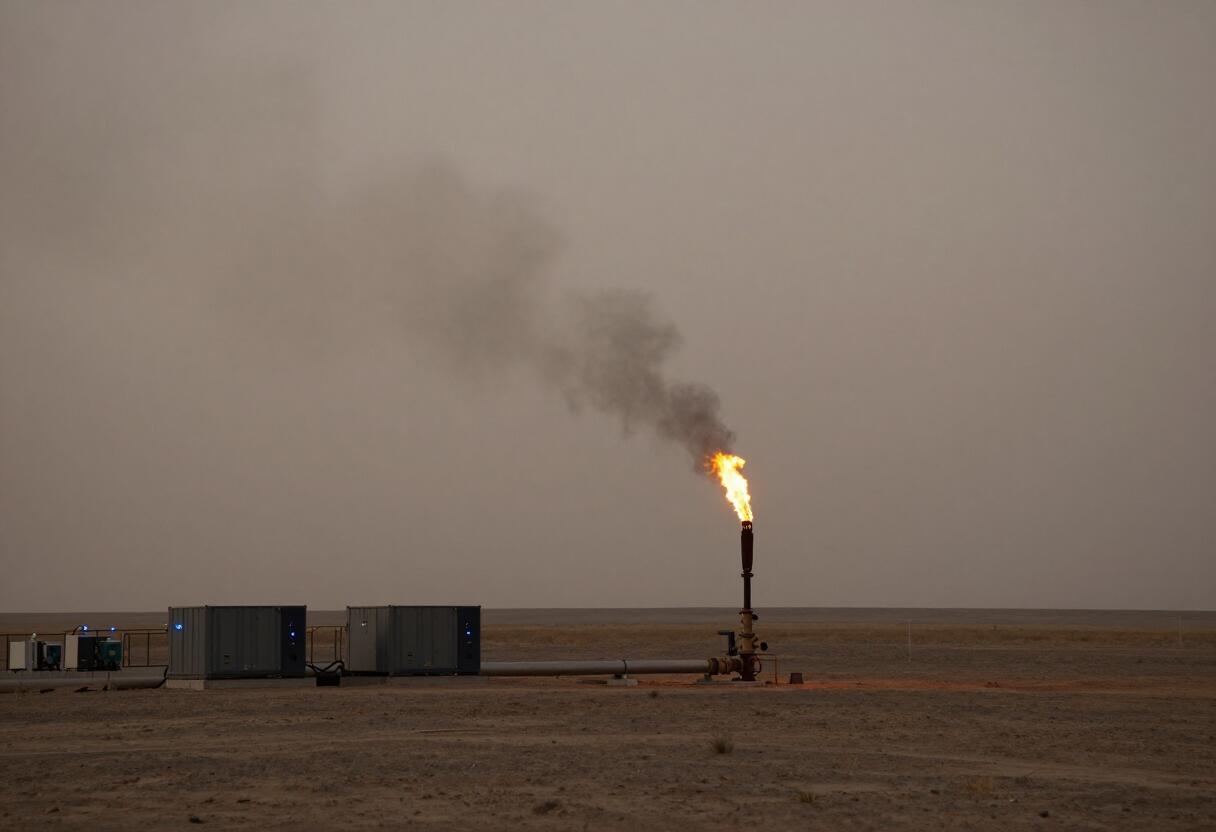
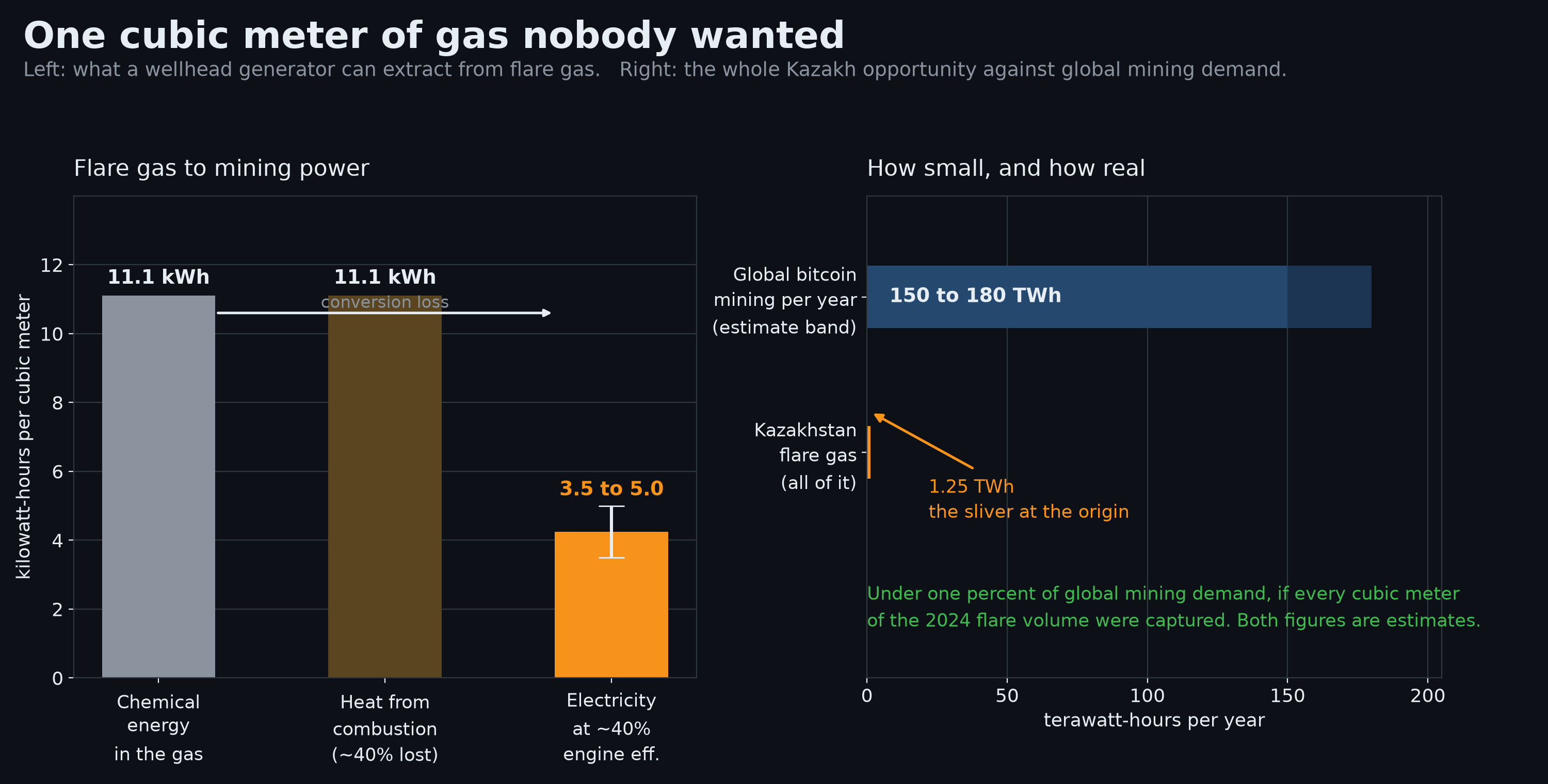
Associated petroleum gas comes up with the crude. At a field with no gathering line and no compressor station there is no buyer and no pipeline, so it burns at the flare. It carries roughly 40 megajoules per cubic meter, a little over 11 kilowatt-hours of heat, and a gas engine at about forty percent efficiency turns that into three and a half to five kilowatt-hours of electricity from what was previously a liability.
Daniyar Mubarakov of Kazakhstan's Blockchain and Digital Mining Association puts the total at 1.2 to 1.3 terawatt-hours if that whole 2024 volume were converted. Check it against the deal structure and it holds. The Ministry of Energy counts 40 to 60 fields. Mubarakov sets the minimum viable size at 5 megawatts per field. Forty fields at that floor is 200 megawatts of nameplate capacity, which implies the units running at roughly half to three-quarters load. The figure is not inflated.
What it also is, is small. Global bitcoin mining consumes roughly 150 to 180 terawatt-hours a year depending on the estimate. Kazakhstan's flare gas, converted entirely, is under one percent of that.
Left: flare gas energy ladder, 40 MJ per cubic meter down to 3.5-5.0 kWh of electricity. Right: 1.25 TWh against a global mining band of 150-180 TWh. Own diagram, figures attributed.
The interesting question is not size. It is direction.
The architecture is the argument
Kazakhstan's first mining boom is the reason the second one looks like this. After China's 2021 ban, miners arrived, plugged into the national grid, and strained an aging system. Shortages produced a political fight, the government answered with an auction-based rationing regime, and most of the industry left. The failure mode was never bitcoin. It was the wire.
Flare gas mining removes the wire. The generation equipment sits at the wellhead, the fuel never enters a pipeline, the electricity never touches a transmission line, and the load cannot be curtailed by a utility because there is no utility in the circuit. The political lever that ended the 2021 wave does not connect to anything.
That is the part worth generalising. Stranded energy, whether gas with no gathering line or hydro in a valley with no transmission corridor, has a common shape: the resource is real, the infrastructure to move it is not, and capital will not build a pipeline whose only customer is speculative.
Bitcoin mining is unusual among electricity consumers in that the consumer is portable and the settlement layer is global. A gas turbine does not need a twenty-year offtake agreement with a utility that has not been built; it needs a market that pays for output in a liquid asset within the hour. The buyer travels to the energy. That inverts the normal order of infrastructure finance.
The decree's contribution is not technology. It is a tariff.
The steel-man, and why it partly holds
The serious objection is not the environmental one. The model monetises methane that was going to be flared anyway, which is a strict improvement on the counterfactual. Burn the gas in an engine rather than a flare stack and the carbon still goes up, but the unburned methane venting from an open flare comes down, and that is a far more potent short-lived pollutant. Governments are starting to price that difference. A state that designates mining as its methane remediation tool has an environmental claim that "bitcoin wastes energy" is not equipped to answer. The argument is real, and it only survives if the gas genuinely was going to be wasted.
The second is that a subsidy large enough to matter eventually changes what it attracts. Below-market gas draws operators whose business model is the discount rather than the mining. Then the framing flips — the state is no longer remediating methane, it is losing revenue — and the political economy that killed the first boom reassembles itself in new vocabulary.
The third is the sequencing one, and it is the strongest. Gizzat Baitursynov, the Vice Minister of AI and Digital Development, has confirmed the governing legal framework is still being written. No draft, no timeline. The tariff schedule and the compliance costs attached later decide whether capital comes; a per-kilowatt levy that eats the discount over auction power sends operators away exactly as in 2021. Everyone is celebrating the opening and nobody has seen the doorframe.
The haystack argument
Peirce's speech belongs in the same file because it is the same move: a regulator conceding that a cryptographic mechanism beats the administrative one it runs.
Her target was KYC data collection, and she did not soften it. "We build ever bigger data haystacks on the theory that we will find a needle or two inside," she said, in a remark published in the SEC's own transcript. "The bigger haystack, however, makes it harder to find the needles." The alternative she named is attribute-based credentials and zero-knowledge proofs: an institution verifies that a customer is not on a sanctions list, or is over eighteen, or is an accredited investor, without collecting and warehousing the underlying documents. The proof travels; the passport scan does not.
What makes that more than an opinion is the paper trail. The SEC's Crypto Task Force met Aztec Laboratorium Limited on 17 July 2026 to evaluate ZKPassport, a system that verifies government identification on the device — brought into the building two months before the speech.
Be precise about what this is. It created no exemption; not one KYC or AML rule changed. Peirce leaves on 2 October, briefly reducing the commission to two members, and her framing survives only if a successor picks it up within the year. Three things would have to exist first: a sandbox where institutions can test identity circuits with legal cover, standardised definitions for the attributes the proofs replace, and one commissioner willing to carry it. None exists. The argument has cleared the credibility threshold, not won.
Notice the symmetry. Both documents write rules for mechanisms the state does not operate. Kazakhstan is not building the gas plant; the SEC is not verifying the proofs. In each case the regulator's real job has shrunk to setting the price of permission and deciding whether the mechanism counts — a narrower role than either institution is used to claiming.
Bitcoin traded at 82,969 dollars on 28 September, per mempool.space's price feed, with the network hashing near 945 exahashes per second. As a scale reference: against 945 exahashes a gigawatt-scale buildout in the steppe is invisible; against the political economy of stranded gas, 40 fields is not.
What I could not verify
Here is what I could not verify. Four claims in this piece are attributed, not settled. The 1.2 to 1.3 terawatt-hour figure is Mubarakov's estimate. I checked it against the field count and the 5-megawatt minimum and it is internally consistent, which is not the same as correct. The 300 to 340 million cubic meter flare volume comes from coverage citing Euronews figures. The price and hashrate are single-source readings from one free endpoint, taken this morning. The 150 to 180 terawatt-hour denominator is a band from published estimates, so the ratio is only as precise as the band.
Kazakhstan has not decided that bitcoin mining is good. It has decided that gas with no buyer is worse. That is the narrower, more durable judgement, and it is one other oil states can copy without ever saying the word bitcoin in public. The regulation that follows will show which reading the government actually holds. Until then the flare stack is still lit, and no engines have been ordered.