Bitcoin crossed 18 ounces of gold for the first time since last autumn and closed the week at 20.49. Three writers read the same chart and produced three different targets, because the number depends entirely on which gold you decide to count.
6 Oct 20263,194 words · 14 minAlso on Nostr as a long-form note
Three things arrived on Friday morning, and they point the same way. American employers added 29,000 jobs in September against a consensus near 84,000. The federal debt stood at 40.2 trillion dollars, having crossed 40 trillion in mid-August for the first time. And the European Union announced it was weighing a release of 50 million barrels of diesel from emergency stocks, a measure whose reported effect was to drop European gasoil futures more than 5 percent and, with them, the long end of the bond market.
Three levers, one problem. The cost of carrying a debt stock has outgrown the economy that issued it, and every available instrument is now being pointed at that number.
Bitcoin did something simpler, and nobody had to announce it. On 18 September it crossed 18 ounces of gold, the first time since last autumn. By Monday it printed 20.64 ounces, a level last seen in December. It closed Tuesday at 20.49. In a week whose news was made of weak hiring, a reserve release and a quiet retreat by a financial regulator, the asset that is priced in nothing at all reached a fifteen-month high against the oldest money there is.
Nik Bhatia, Matthew Sigel and Marty Bent all looked at that same chart in the past five days and told three versions of one story. Their numbers are worth taking apart, because they are not really about bitcoin. They are about gold, and about how much of it you decide to count.
Twenty ounces of gold
Bhatia published a piece on 6 October titled with the arithmetic of a much older argument: there are 138 ounces of monetary gold in existence for every single bitcoin. He frames the trade as a choice rather than a forecast. Would you rather own 138 ounces of gold or one bitcoin? Today that ratio is a little over 20, meaning the coin buys roughly twenty ounces, and a return to parity on his basket would put a bitcoin at 573,000 dollars. He calls it a 7x from here and says he is willing to wait until the 2030s.
Sigel, in an interview published on 5 October, used a different denominator. Bitcoin capturing half of gold's total market capitalization is his north star, which implies roughly 500,000 dollars per coin, achievable this cycle or the next. He puts the BTC-to-gold ratio at 16 to 17 on the summer lows, having peaked near 40.
Bent put the chart in front of his readers on 5 October with the plainest sentence of the three. Bitcoin has broken above resistance around 18 ounces per coin and kept going, so an ounce of gold buys less bitcoin than it did a month ago. He thinks it is ready to rip.
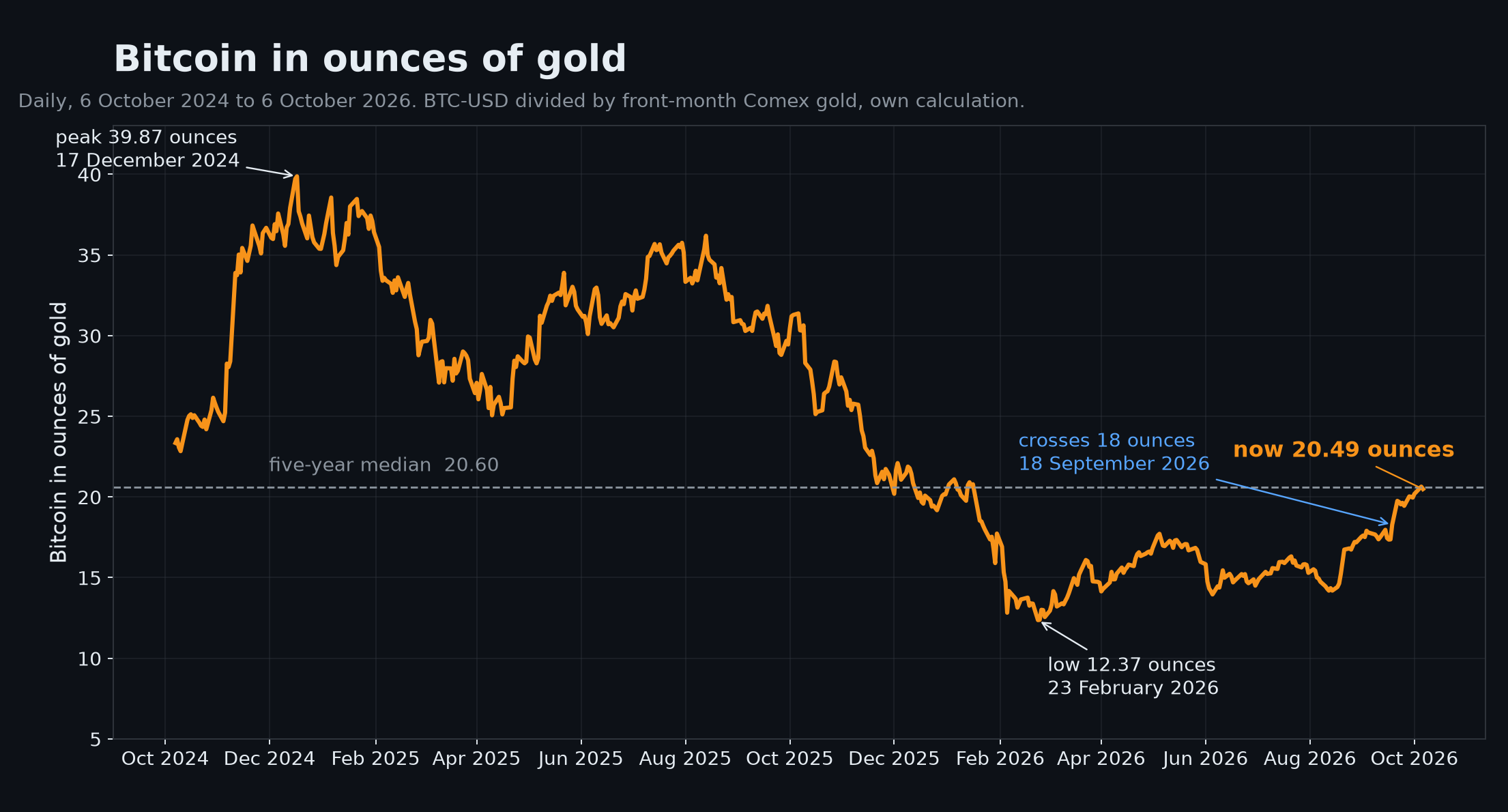
I rebuilt the series to see how the three claims sit against the tape [own calculation, Yahoo Finance daily closes for BTC-USD and front-month Comex gold, 6 October 2024 to 6 October 2026]. Today's ratio is 20.49 ounces. The 17 December 2024 peak was 39.87. The 23 February 2026 low was 12.37. One year ago, on 6 October 2025, the ratio was 31.37. The move Bent is describing is real and steep: from the February low to Tuesday, the coin gained 65.7 percent against gold.
It is also, looked at over twelve months, a recovery and not a breakout. Bitcoin is down 34.7 percent against gold since last October, and the ratio sits essentially where it started this year, at 20.77 on 2 January versus 20.49 now, a decline of 1.4 percent. The ten-year median of the series is 13.31. Today's level is the 69th percentile of ten years of daily observations, and the 49th percentile of five. The forty-ounce peak that everyone now treats as a reference point happened once, for a few weeks, fourteen months ago.
Chart. Bitcoin priced in ounces of gold, daily from 6 October 2024 to 6 October 2026. The line rises to a peak of 39.87 ounces on 17 December 2024, falls to 12.37 on 23 February 2026, crosses 18 ounces on 18 September 2026 and ends at 20.49. A dashed line marks the five-year median of 20.60. Own chart, Yahoo Finance daily closes for BTC-USD and front-month Comex gold.
The arithmetic inside 138
A ratio of 138 ounces sounds like a measurement of bitcoin's scarcity. It is a measurement of gold's supply, divided by bitcoin's, at a price that gold sets.
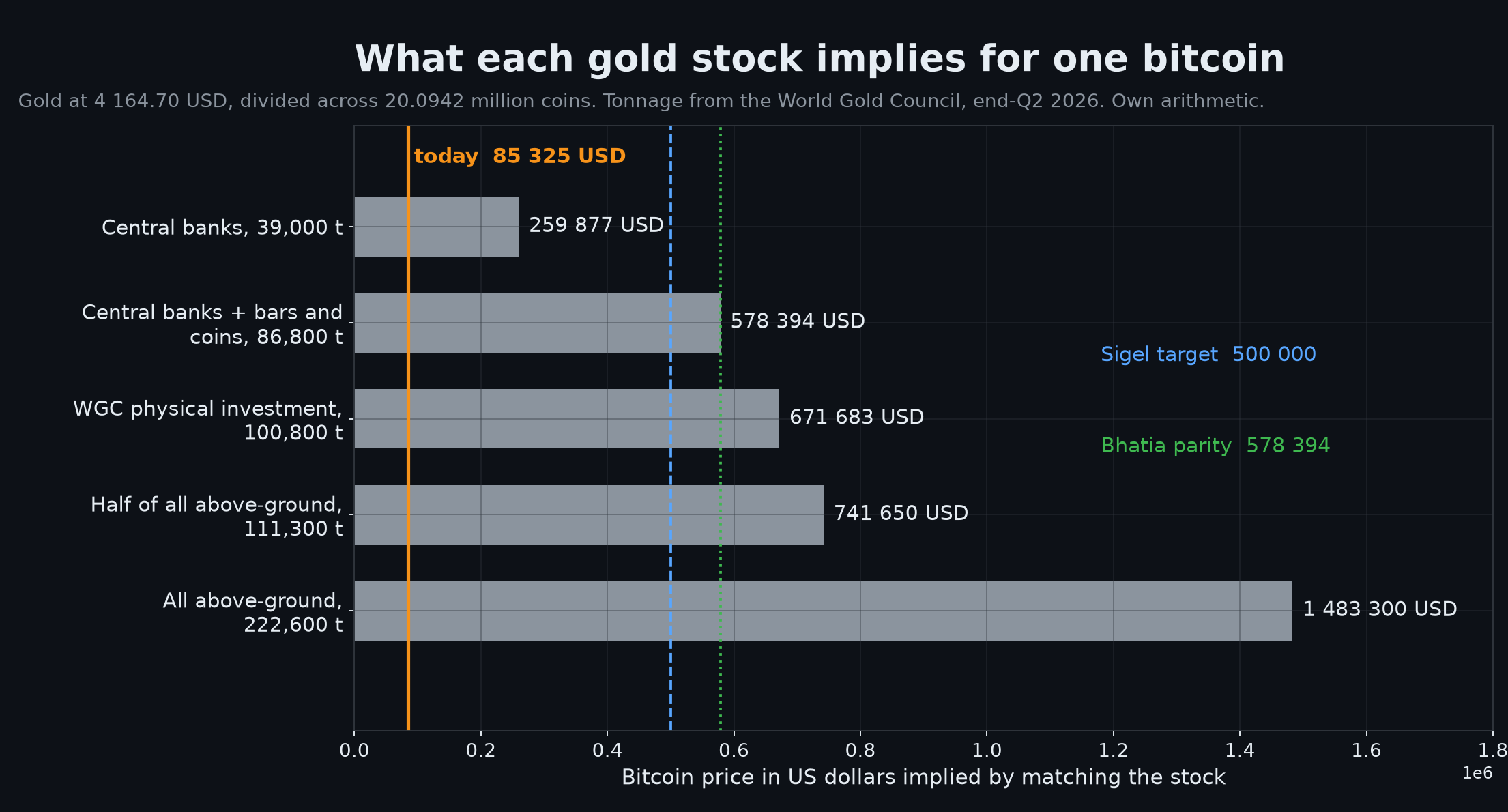
His basket is central banks, gold ETFs and private bar storage, over 80,000 tonnes in total. At Tuesday's gold price of 4,164.70 dollars, 138 ounces are worth 574,729 dollars, so his parity price of 573,000 is consistent to within the price of the metal on the day he wrote [own multiplication]. That check matters, because it means the target is not a bitcoin number at all. Hold the basket fixed and the parity price is a function of the gold price alone. Gold at 4,152 dollars gives you 573,000. Gold at 2,808 dollars gives you 500,000, which is Sigel's number arrived at from a different pile of metal entirely.
Here is the ladder, on the World Gold Council's own tonnage, priced at Tuesday's gold and divided across the 20.0942 million coins that had been mined as of block 970,146 [own reconstruction: supply from block subsidy arithmetic, tonnage from the WGC's above-ground stock as of end-Q2 2026, all division mine].
Central banks alone, 39,000 tonnes: 62.4 ounces per coin, 259,877 dollars.
Central banks plus bars and coins, 86,800 tonnes: 138.9 ounces, 578,394 dollars.
Two things fall out of that. First, Sigel's "half of gold" and Bhatia's "138 ounces" are the same method with different stock definitions, and both are further from today's price than they sound, because both are far below the top rung. Second, the widely quoted line that bitcoin is about 5 percent of gold is true only against all gold on earth, jewellery included: 1.715 trillion dollars of bitcoin against 29.81 trillion of metal [own multiplication, WGC end-Q2 stock at Tuesday's gold price]. Measured against the WGC's own investment categories, bitcoin is 14.8 percent of the metal. Same asset, two very different sentences.
Chart. Horizontal bars showing the bitcoin price implied at Tuesday's gold price of 4,164.70 dollars if bitcoin were to match six different gold stock definitions, from central-bank holdings of 39,000 tonnes on the left to all above-ground gold of 222,600 tonnes on the right. The implied prices run from 259,877 dollars to 1,483,300 dollars. Markers show today's price of 85,325 dollars, the 500,000-dollar target attributed to Sigel and the 573,000-dollar parity in Bhatia's basket. Own arithmetic, WGC tonnage.
The other side of the trade
Read the year instead of the fortnight and the story changes shape. Bitcoin opened 2 January at 89,944.70 dollars and stands at 85,324.83, down 5.1 percent. Gold opened the year at 4,329.60 and is at 4,164.70, down 3.8 percent. The S&P 500 is up 13.4 percent, at 7,773.95, less than one percent below its 13 August record. Over twelve months the split is starker: bitcoin down 31.6 percent, gold up 4.7 percent, the index up 15.3 percent. Every figure is an own division of daily closes [Yahoo Finance].
That is the year in which the ten-year Treasury yield rose to 5.31 percent and the thirty-year to 5.665 percent, both the highest readings since the early 2000s. It was, simultaneously, a poor year to own the two assets sold as protection against exactly that.
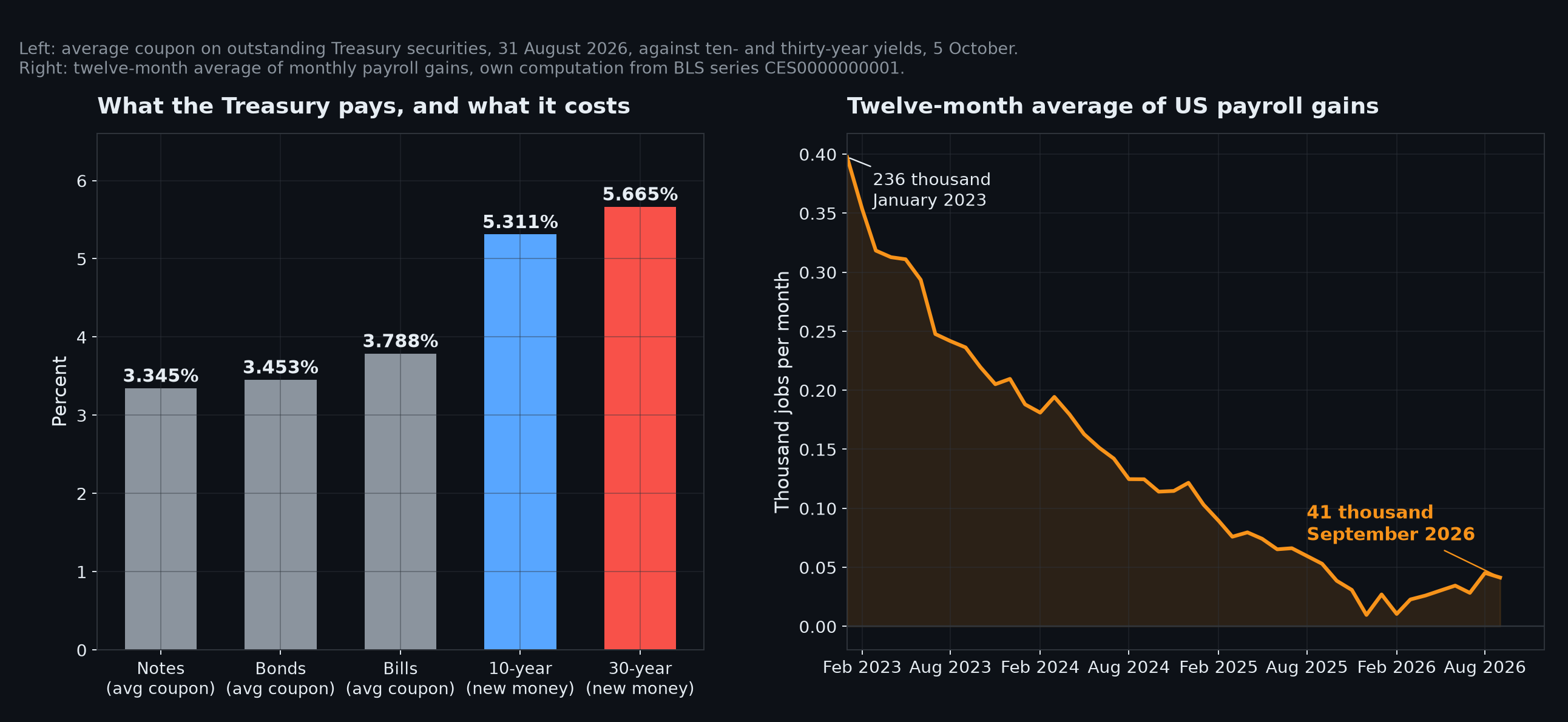
The mechanism is not mysterious, and it is arithmetically brutal. The average interest rate the Treasury is paying on its outstanding notes is 3.345 percent, on its bonds 3.453, on its bills 3.788, as of 31 August. The marginal cost of new money is the ten-year at 5.311. Rerun the stock at the marginal rate instead of the blended one and the bill goes from between 1.35 and 1.39 trillion dollars a year to 2.14 trillion [own multiplication; the 40.24 trillion is Treasury's debt-to-the-penny figure for 2 October, crossing 40 trillion on 18 August at 40.0474]. The rollover alone is worth something between 750 and 790 billion dollars a year of extra interest, and it arrives whether or not anything is actually built with the money.
Set that against the labour market. The twelve-month average of monthly payroll gains is 41,300. A year earlier it was 53,000. Two years earlier, 124,600. Three years earlier, 236,200 [own computation from BLS series CES0000000001]. Average hourly earnings came in at 37.81 dollars in September, up 3.02 percent year over year, against a risk-free ten-year yield of 5.31 [own division of BLS series CES0500000003]. A worker's wage is growing more than two percentage points slower than the rate at which his government can borrow for a decade.
That is what makes weak payrolls useful rather than merely bad. A soft labour market removes the argument for tightening, which removes the pressure on the long end, which keeps the refinancing bill from compounding faster than it already is. Thomas Simons of Jefferies, quoted in the coverage Bent carried, called the number the nail in the coffin for an October hike, and the bond market behaved as if he was right.
Chart. Two panels. Left: the average coupon the Treasury pays on outstanding notes at 3.345 percent, bonds at 3.453 and bills at 3.788, against the ten-year yield of 5.311 and the thirty-year of 5.665 percent on 5 October 2026. Right: the twelve-month average of monthly US payroll gains, falling from 236,000 in January 2023 to 41,300 in September 2026. Own chart, Treasury average interest rates and BLS series CES0000000001.
What a 29,000 is for
The September figure was worse than the headline. July went from plus 21,000 to minus 10,000, an outright loss. August was cut from 162,000 to 133,000. Two months of prior data lost 60,000 jobs in the same release that printed the 29,000 [BLS series CES0000000001, own subtraction of the level series: June 158,892 thousand, July 158,882, August 159,015, September 159,044]. I checked those against the published series and they hold exactly.
On the same morning, the diesel announcement. France proposed releasing 50 million barrels from EU emergency stocks over two months, paired with a separate 50-million-barrel IEA crude release. European gasoil futures fell more than 5 percent to around 1,380.50 dollars a metric ton on the news, as Reuters reported it and Bent carried it. Fifty million barrels is roughly 17 percent of EU emergency diesel stocks and about 3 percent of annual consumption. The characterization that the reserves were already available for private sale before the announcement comes from Michael Every of Rabobank, distributed through ZeroHedge, and I could not find it in a European Commission primary release. The price response, on the other hand, is not in dispute.
Two levers, one objective. Yields came down on the same morning for two unrelated reasons, and neither of them was that the debt got smaller.
The steel-man here is not weak, and it belongs to Bhatia. As Bhatia reported it, two of the Fed's most important voices spoke dovishly in the same week. John Williams saw no need for urgency after the September move, and Philip Jefferson said further adjustment may take more time. If the economy is genuinely slowing, with the Atlanta Fed's third-quarter estimate cut and consumption weak in the lower half of the income distribution as Bhatia reads it, then the long end is not expensive because capital is scarce. It is expensive because a deficit is being financed into an economy that may be weaker than the headline suggests, and the next move in the long end is down. In that reading, the fiscal-dominance trade is a growth story, not an inflation story, and it still ends with money that cannot be printed losing its discount.
What the steel-man does not yet explain is the shape of the curve. The front end fell in that week and the long end rose. If the market believed a slowdown, the whole curve would move together. Instead everyone agrees the policy rate is near its peak and nobody agrees on the price of money for thirty years. That disagreement is about term premium, and term premium is what the 40-trillion-dollar arithmetic above is made of.
The fence around gold
Cory Klippsten asked the question on 2 October that none of the dollar-denominated targets can answer. China lets its citizens buy gold and does almost everything it can to stop them buying bitcoin. Why?
The numbers he cites make the first half concrete. Chinese investor demand for gold bars and coins hit a record 314 tonnes in the first half of the year, on his reading of the trade data. Including banks and institutions, China imported more than 1,000 tonnes in the first eight months, spending 158.8 billion dollars against 96.5 billion in all of last year. The People's Bank reported another 20 tonnes in August, its 22nd consecutive month of purchases, taking official holdings to 2,387 tonnes. And yet withdrawals from the Shanghai Gold Exchange fell to 62 tonnes in August, down 27 percent from a year earlier. Record metal is entering the country while the best measure of wholesale physical demand goes quiet. Somebody inside China is stockpiling tonnes that never reach a retail counter.
Klippsten also does the honest thing that most writers skip. He says he went looking for evidence that China is settling its trade surplus in gold, a thesis he read in Luke Gromen's work, and could not find it. Chinese exporters are paid in currencies and some of those proceeds come back as metal. That is a savings allocation, not a settlement rail, and he is right to refuse the stronger claim. The same data supports a narrower and more interesting reading: China has been converting a dollar reserve into a hard one. Its reported US Treasury holdings peaked above 1.3 trillion in 2013 and are now a little over 600 billion, less than half. This summer Hong Kong launched a government-owned clearing and settlement system for physical 400-ounce bars, with the Shanghai Gold Exchange on the board. The infrastructure is being built for gold to move in circuits outside the Western one.
Then the answer to the question. The gold stays inside a fence the party controls. It can be bought through banks, held as bars, held through ETFs, and it cannot leave the country in quantity without customs becoming involved. A kilogram of metal has to physically cross a border and is easy to seize. Twelve words go through customs in a man's head.
That is the whole distinction, and it explains a piece of American policy that arrived on the same Monday. FinCEN announced it is withdrawing two proposed rules that would have built the fence from the other side. The 2020 proposal on unhosted wallets would have required banks and money services businesses to keep records on transactions with self-custody wallets above 3,000 dollars and file reports above 10,000, turning every exchange and bank that touched a hardware wallet into a compliance officer for a non-customer. The 2023 proposal would have designated convertible virtual currency mixing as a primary money laundering concern and required reporting on mixing-linked transactions that involved a foreign jurisdiction, including addresses, transaction hashes and IP addresses. Both were reported by Marty Bent on 5 October as withdrawn, with Federal Register publication scheduled for 6 October. When I checked the Federal Register API this morning, the latest FinCEN entry visible was still the previous day's, so I can confirm the announcement as reported and not the publication itself.
On the same 5 October, FinCEN did propose a new special measure, against companies controlled by the A7 Network, described in the notice as a sanctions evasion and money laundering service with ties to Russia, leveraged by Iran and its terrorist proxies. It is published at 91 FR 63209, docket FINCEN-2026-0265, with comments due 4 November. Read the two documents as one policy and the perimeter becomes visible. Two rules aimed at the ledger, withdrawn. One rule aimed at a network of foreign intermediaries, proposed. The state is not conceding the argument about money. It is redrawing the fence so that it runs around companies it can subpoena rather than around keys it cannot.
What the ratio will and will not tell you
There is a falsifiable version of this week, and it is short. The ratio is 20.49 ounces. If it merely returns to its December 2024 peak of 39.87 and gold does not move, bitcoin is at 166,000 dollars [own multiplication of Tuesday's closes]. If gold instead returns to its 2 January level of 4,329.60 while bitcoin stays where it is, the ratio is 19.71 and the whole fifteen-month breakout disappears. If gold halves, the ratio passes forty and bitcoin doubles against the metal without a single new buyer. The direction of the ratio is a two-variable problem, and the louder half of the audience is only watching one of them.
The counterweight is the ten-year median of 13.31. Both statements are true at once: bitcoin is recovering strongly against gold from a February low, and it is still above the typical level of the last decade after twelve months in which it lost a third of its value against the same metal. The ratio has no law. Anyone quoting 138 ounces as if it were gravity is quoting a supply division with a moving numerator.
Five things in this piece I could not verify and will not dress up as measurements. Sigel's characterization of miners' 10-to-20-year power leases as investment-grade is his, and no public register of those contracts exists. Bhatia's "over 80,000 tonnes" is his composition; my reconstruction of central banks plus bars and coins lands at 86,800 tonnes, which is close in size but mine, not his. The 20-billion-dollar figure for the frozen Turkish funds is second-hand from TFTC and an upper estimate by a regulator that has not published a final recovery number. The diesel-stock characterization rests on one analyst. And the FinCEN withdrawals are announced but not yet visible in the register I can query.
Here is the consequence worth carrying out of this week. The two numbers that matter most on Friday were not the ones in the headlines. They were 3.345 percent, the average coupon the Treasury pays on its notes, and 5.311, the price of new ten-year money. That gap is the reason a soft payroll print is treated as relief, the reason a 50-million-barrel reserve release moves bond futures, and the reason a regulator withdrew two surveillance rules it spent years drafting. None of it is about bitcoin, and all of it is about what a dollar is for.
Against gold, bitcoin is at twenty ounces this morning, exactly where it started the year. If you wait for the ratio to move, you will be told a story about adoption. The ratio will be about gold.