The Hedge Went Quiet
Bitcoin beat the SpaceX IPO by 34 percent and still lost money in 2026, while gold lost more. That is the year the debasement trade went on sale, and Turkey showed why the custody case does not need a price.
Bitcoin beat the SpaceX IPO by 34 percent and still lost money in 2026, while gold lost more. That is the year the debasement trade went on sale, and Turkey showed why the custody case does not need a price.
On 12 June the most anticipated equity of the year began trading, and in the sixteen weeks since, bitcoin has beaten it by about 34 percent. That is the cheerful half of this quarter. It is also the only half that gets quoted, and the interesting question sits in the other one.
Cory Klippsten makes the comparison in his note of 3 October, and he makes it well. SpaceX listed on 12 June. Since that first-day close bitcoin is up "over 35 percent", he writes, while SpaceX is down about 8. Now Anthropic is reportedly preparing to go public at a valuation between 1.8 and 2.0 trillion dollars, targeting a raise of 100 billion and carrying more than 500 billion dollars of compute commitments over the coming decade that it mostly cannot cancel. All the bitcoin in the world is worth about 1.7 trillion. The new listing, at the rumoured price, would be a larger object than the entire monetary asset combined.
I measured the "over 35 percent". Bitcoin closed at 63,531 dollars on 12 June on Bitstamp. It closed at 84,961 on 4 October. That is 33.7 percent [own division of two Bitstamp daily closes]. The direction is Klippsten's; the number is a little better than the tape.
Then he does the arithmetic that matters, and the arithmetic holds. At 84,912 dollars, the Kraken daily close for 4 October, a tenfold return means 849,120 dollars a coin. Against a supply of 20.08 million coins that is a 17.05 trillion dollar asset [own multiplication, supply from the mempool-based on-chain feed]. Anthropic has to reach 20 trillion dollars from two, and it has to do it before dilution that its own capital needs make likely. The two finish lines are close to the same distance. What differs is everything about the ground between here and there. Anthropic has to keep winning. Bitcoin has to keep existing.
So far so familiar. The part that is not familiar is what the same two assets do when you stretch the window to the whole year, because 2026 has been almost nothing like the story bitcoin's holders tell about it.
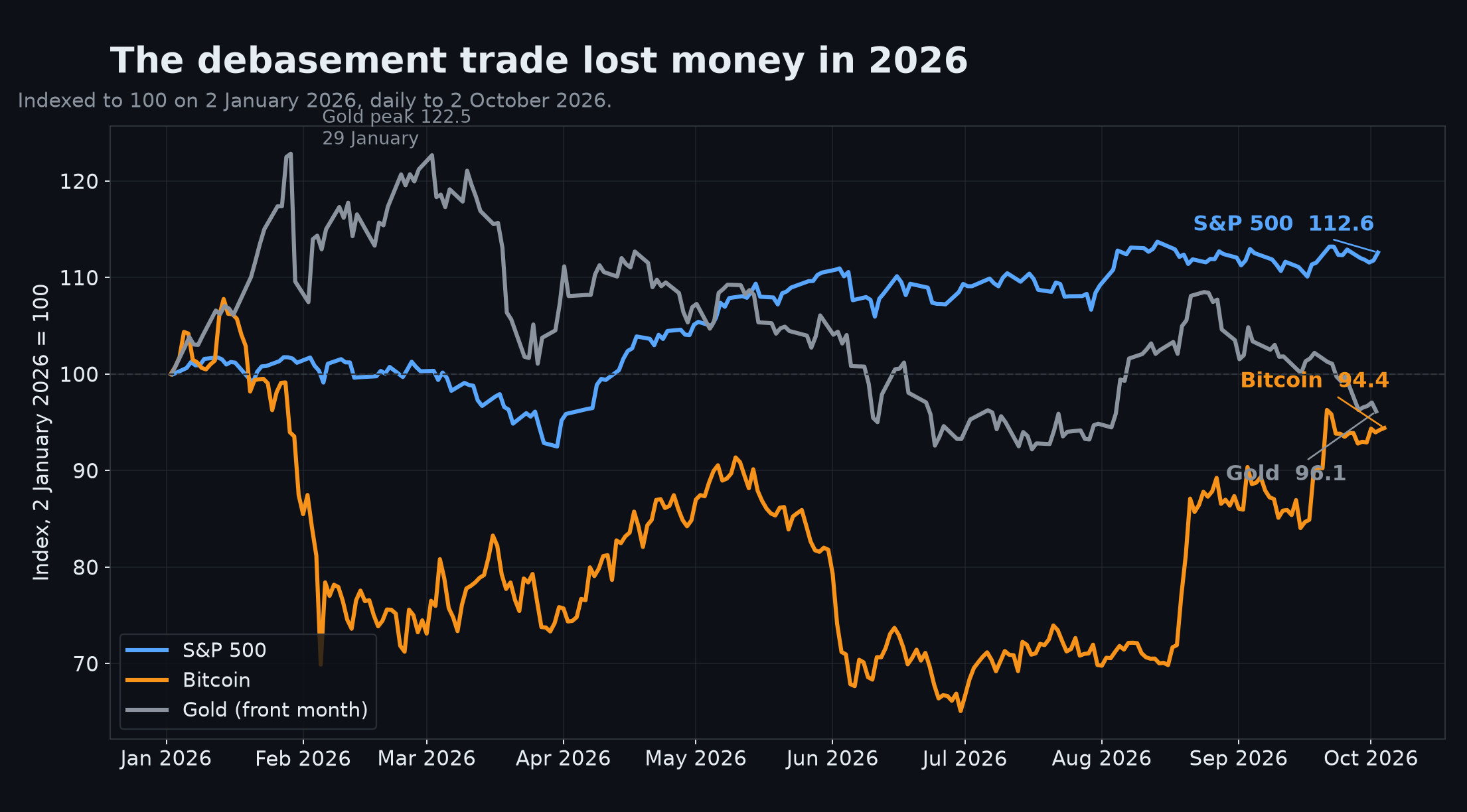
Bitcoin closed 2 January at 89,934 dollars. It closed 4 October at 84,912. That is a loss of 5.6 percent for the year, nine months in, and it is the good news relative to gold. The front-month Comex gold contract closed 2 January at 4,329.60 dollars and 2 October at 4,162.30. Gold is down 3.9 percent for the year, and it is down 21.7 percent from the 5,318.40 it printed on 29 January [own divisions of daily closes, chart data below].
The S&P 500, over the same nine months, is up 12.6 percent, closing 2 October at 7,722.72. The VIX closed at 15.31. Nothing in the equity market is pricing a crisis; the index is within one percent of its 13 August record of 7,798.99.
Read those four lines together and you have the fact that no one in this debate wants to say out loud. The ten-year Treasury yield reached its highest level since 2002 this year. The thirty-year reached a level last seen in 2001. The American government financed a 40 trillion dollar debt stock at a market rate that keeps rising. And that same year was a bad year to own the two assets sold as protection against exactly that. The protection did not get more expensive. It got cheaper, while the thing it was supposed to protect against got worse.
That is not a refutation of the thesis. It is a precise statement about which repricing this is.
Take the ten-year Treasury apart and the mechanism stops being mysterious.
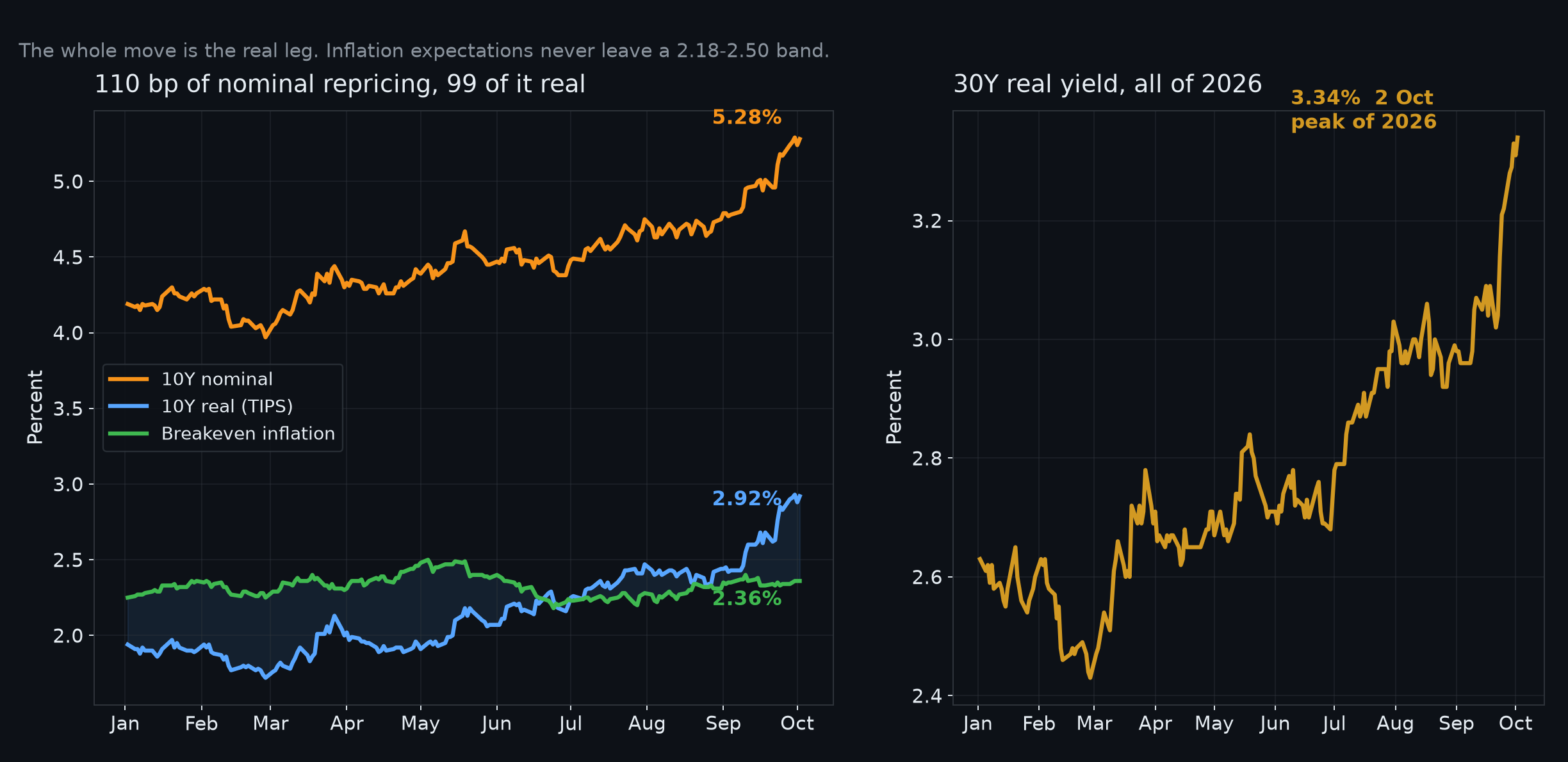
On 2 January the ten-year nominal yield was 4.19 percent and the ten-year real yield, from inflation-protected securities, was 1.94. The difference, the breakeven inflation rate, was 2.25 percent. On 30 September the nominal was 5.29 and the real was 2.93. The breakeven was 2.36 [US Treasury daily nominal and real yield curves, 2026].
Nominal repricing: 110 basis points. Real repricing: 99. Inflation expectations: 11.
Nine tenths of the move is not a bet on higher prices. It is lenders demanding a higher real return for giving up their capital for a decade. Through the whole year the breakeven has stayed inside a band of 2.18 to 2.50 percent [own min and max of 190 daily observations], which is what an anchored inflation expectation looks like in a market that has repriced almost everything else.
The thirty-year real yield has behaved the same way and more so. It closed 2 October at 3.34 percent, the highest reading in the Treasury's 2026 daily real curve, after 3.33 on 30 September. Both are above the ten-year real, which is the normal shape. Both are also the kind of level that changes how a pension fund, an insurer and a life office think about the price of every long-lived asset on their books.
That is what duration means, and it is the cleanest way to see why bitcoin spent this year trading like a technology stock. Bitcoin has no cash flows today. Its entire value sits in a terminal state far in the future. That makes it the longest-dated asset in any portfolio, and a rise in the discount rate is supposed to hurt the longest-dated asset most. Scarcity does not enter into it until the repricing is about the currency itself rather than about the real return on capital.
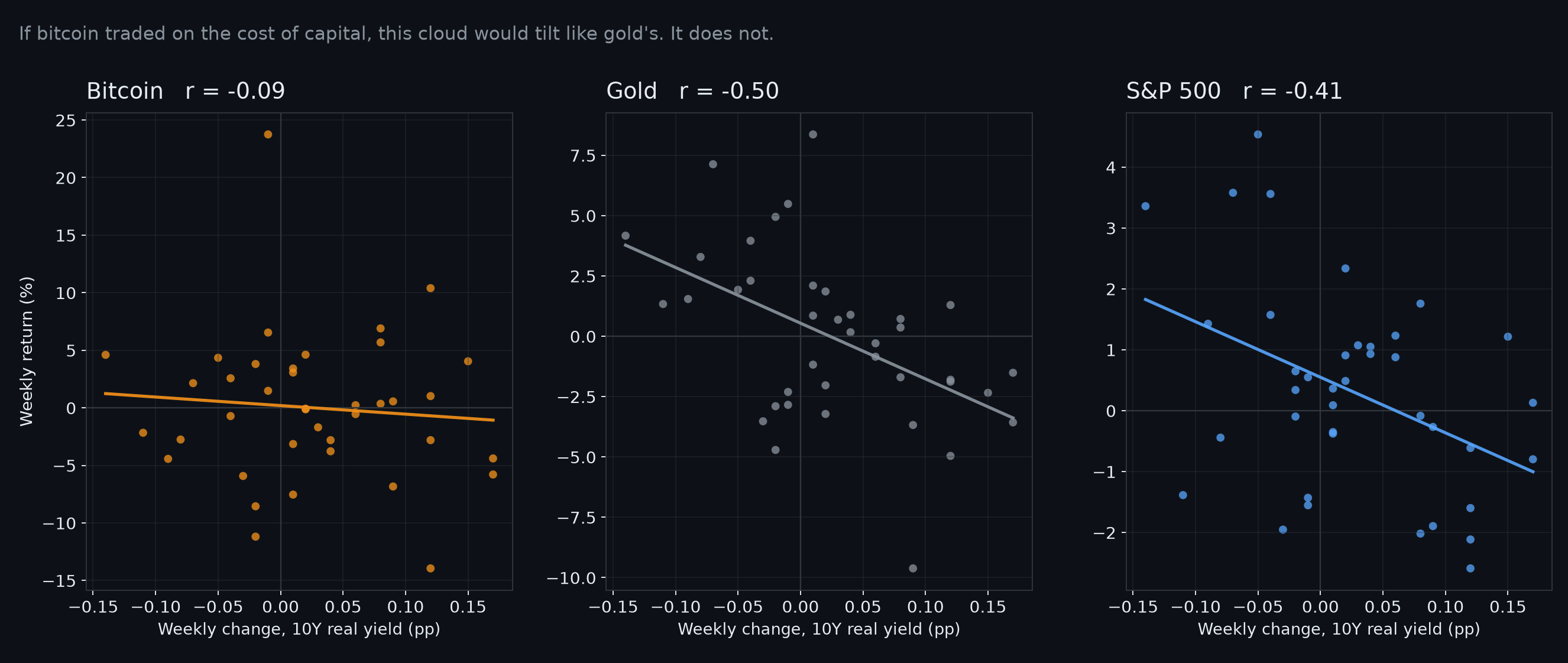
I tested that on the data. Taking Friday closes through 2026 for bitcoin, gold and the S&P 500 and the corresponding daily ten-year real yield, then correlating the weekly changes, the results are these: gold minus 0.50, the S&P 500 minus 0.42, bitcoin minus 0.09 [own calculation, 40 weekly observations each]. Bitcoin's weekly moves are almost unrelated to the real yield. Gold's are strongly and negatively related, which is what a real asset with no cash flow and no earnings should do. Bitcoin, in the year of the great capital repricing, behaved like neither a duration asset nor an inflation hedge. It behaved like something with its own bid and its own story, moving on flows rather than on rates.
There is a second, quieter number that fits. The exchange-traded funds bought a net 2,314.9 million dollars of bitcoin over the fourteen trading days from 15 September to 2 October, eleven up days against three down, with the single largest day on 21 September at 999.0 million [Farside, via the local dashboard]. Since 17 September the net is 3,061.2 million. Money is arriving. It is just arriving into a market where the price has not followed it, because something on the other side of the book is selling. Fear and Greed sat at 65 on 4 October. It was 78 on 22 September and 50 on 17 September — a market that is neither panicking nor celebrating [Alternative.me index, via the local dashboard].
There is a serious case that all of the above is normalisation rather than dislocation, and it deserves its strongest form.
Nik Bhatia of The Bitcoin Layer made it in his 2 October letter. Two of the Fed's most important voices, New York Fed President John Williams and Vice-Chair Philip Jefferson, spoke dovishly in the same week. Williams said there was "no need for urgency" after the September move. Jefferson said any further adjustment "may take more time". Average hourly earnings missed, and the year-over-year growth rate of wages kept falling. The two-year Treasury, the coupon that tracks the policy path most tightly, gave back six basis points in the week from 4.89 to 4.83 percent, while the thirty-year added four, from 5.59 to 5.63 [US Treasury daily yield curve, 29 September and 2 October]. Ten basis points of steepening in one week, and it is exactly the bull steepener Bhatia describes. The market is telling you the front end is anchored and the long end is where the disagreement lives.
Bhatia's economic read is the part that should worry the bears rather than the bulls. The Atlanta Fed's GDPNow estimate for the third quarter came down from 5 percent to 3.7, with net exports as the drag. Consumption by the lower half of the income distribution is weak, and the strength that remains is concentrated in households whose spending is tied to the wealth effect from an AI-driven equity market. Even the construction data splits: residential jobs diverging from non-residential, which is a labour market that depends on the capex cycle. And the euro area, on his reading, is the United States without the AI tailwind.
If that is right, then the long end is not cheap because capital is scarce. It is expensive because a fiscal deficit is being financed into an economy that may be weaker than the headline suggests, and the next move in the long end could be down, not up. The dovish speakers are the leading edge of that.
Here is what the steel-man does not yet explain. The front end fell six basis points last week and the long end rose four. If the market believed a slowdown was coming, the whole curve would have moved down together. It did not. The disagreement is precisely located: everyone now agrees the policy rate is close to its peak for this cycle, and nobody agrees on the price of money for thirty years. That split is a statement about the term premium, not about growth.
Two things in this piece I am carrying second-hand and could not check at source. The SpaceX performance since 12 June is Klippsten's figure, and I could not verify it independently — I checked only the bitcoin side of the comparison, not the equity. The Anthropic numbers — the 1.8 to 2.0 trillion range, the 100 billion raise and the 500 billion of compute commitments — are as reported in his note from elsewhere, and I have no filing to point to. They carry the argument's shape; they are not measurements I made.
And the mortgage data says the long end's opinion is the one that reaches households. The thirty-year fixed mortgage sat at 7.28 percent in the first week of October, against 6.71 in early September [Freddie Mac Primary Mortgage Market Survey]. A borrower looking at that number is not reading Williams's speech. He is reading the term premium, and the term premium is telling him to wait.
Everything above is about the price of the hedge. There is a second argument running this week, and it does not depend on the price of anything.
Marty Bent carried the story on 3 October: Turkey's Capital Markets Board ordered the liquidation of 131 funds managed by seven Istanbul portfolio companies on 17 September, freezing accounts for 455,758 retail investors and assets estimated at up to 20 billion dollars. The recovery plan announced on 1 October caps interim payments at 1 million lira, about 20,400 dollars, per investor per fund. Money-market funds pay first, the rest follow in descending order of investor count, and the liquidation period was extended from three months to six. Alongside the cap, the regulator opened "Voluntary Return Accounts" at a state bank, through the deposit insurer, inviting investors who sold before the freeze at a profit to give the gains back.
Run the two published numbers against each other. Twenty billion dollars across 455,758 investors is an average claim of about 43,900 dollars. The interim cap, then, covers roughly 46 percent of it [own division of the SPK figures as reported by TFTC]. That average is itself soft, because the 20 billion is an upper estimate and the cap applies per fund rather than per person. Nobody knows what the liquidation recovers, because the assets are alleged by prosecutors to have been inflated far above fair value through coordinated trading in low-float stocks. The alleged flight path is specific: prosecutors in Istanbul say the Pusula chairman moved 2.89 billion lira to an account at Edmond de Rothschild in Switzerland on 1 September, two weeks before his firm defaulted. Eighty-five people have been jailed in the related probes as of 3 October.
Strip the country and the currency out and read the sequence: a licensed, regulated, government-supervised intermediary used client money to support positions it controlled, published net asset values that overstated the assets, and took its own exit before closing the gate. That is Celsius. That is BlockFi. That is Genesis. The legal wrapper changes; the mechanism does not.
The interesting legal novelty is smaller and sharper than the collapse itself. The "voluntary return" desk makes explicit what regulators normally leave implicit: a realised, withdrawn gain can be reclassified by the state as excessive, and the remedy is a bank transfer. The leniency provision is sterner still — pay twice your gain, minimum 500,000 lira, within 15 days of a criminal complaint, and the proceeds go to the Treasury rather than to the people who lost money. That is a property-rights question wearing a procedural costume.
The finance minister's framing is that this is not a systemic problem, pointing to public debt at 22 percent of GDP and a budget deficit about half the developing-country average. He may be right about the debt. He is not talking about custody. The 455,758 people locked out did everything a conventional system asks: licensed managers, a supervised platform, an inflation hedge because the lira was losing value and real yields were negative. They still woke up with a withdrawal cap.
Put the two halves of this week next to each other and something useful appears.
The case for holding an asset you control yourself got stronger this week, visibly, in a country that is not in crisis by its own fiscal arithmetic. It got stronger because of a mechanism — the custodian controls the gate — that has no price. Meanwhile the price of the asset you would hold instead fell, in a year when the thing self-custody protects against became more expensive by every official measure.
That is not a contradiction. It is what a hedge is. A hedge you buy because the machinery might break pays off in the state where the machinery breaks. It does not pay off in the state where the price of long money simply goes up. 2026 has been the second state for nine months, and it has been the first state, in miniature, in Istanbul — where it happened without a single dollar of stress in the dollar system, which is precisely why it is worth reading.
Bent himself sets out the falsifiable version, and I will adopt it. If Turkey's voluntary accounts attract a meaningful share of the gap without criminal enforcement, and if the liquidation makes most retail investors nearly whole, then informal norms did the work that a custody framework could not. Watch two numbers over the next sixty days — the inflows into those accounts, and the recovery rate of the liquidation against the alleged inflated values. My expectation is that the second number is brutal, and that the only mechanism which moves material sums will be the criminal one, which outlasts the liquidation schedule.
Which leaves the sentence to carry into next year, and it is not a bullish one or a bearish one. Bitcoin is priced today as a long-duration asset with its own bid: correlated to nothing in particular, bought steadily through the funds, held down by something on the other side. The scarcity argument and the price disagree, and both are true at once. The asset with the fixed supply spent the year being repriced by the cost of capital, and the need for the properties that make it what it is was demonstrated, at retail scale, in a market that has nothing to do with it. The thesis got stronger while the trade went quiet. Anyone holding for the first reason should understand that the second reason is what they are actually paying for.