The Fed raised rates into a supply-shock inflation problem for the first time in three years, the 10-year pushed toward 5%, and bitcoin rallied anyway. A liquidity model admits it is not working - and the reason says more about the Fed's trap than about the tape.
23 Sep 20261,186 words · 5 minAlso on Nostr as a long-form note
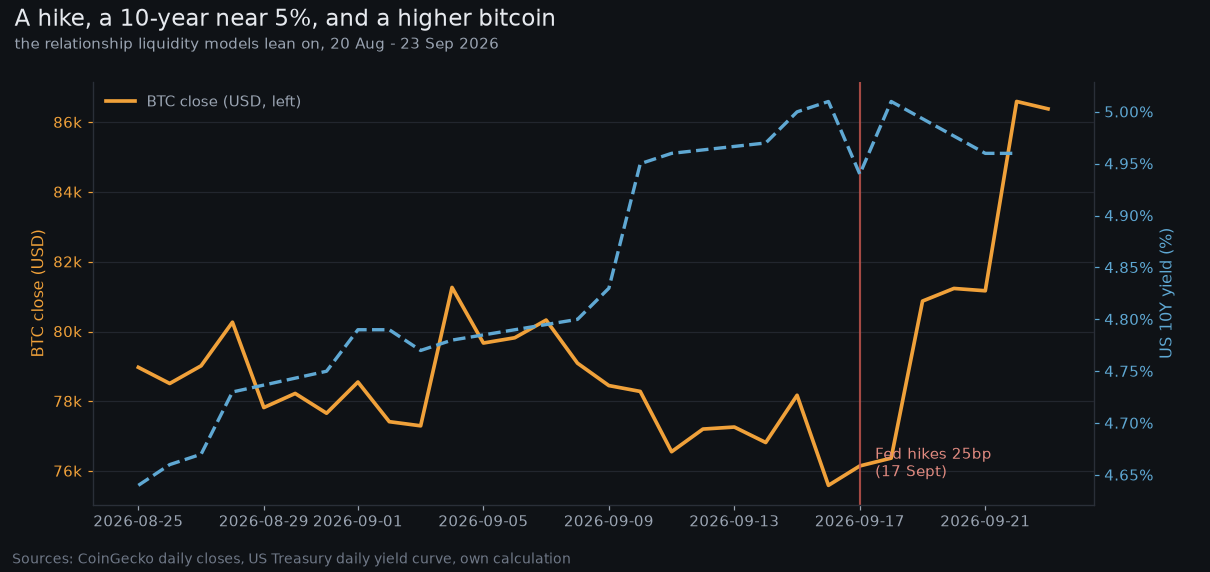
On September 17, the Federal Reserve raised its policy rate for the first time in three years. The effective federal funds rate moved from 3.63% to 3.88% in a single day, and the target band went to 3.75–4.00%. Bitcoin closed that Thursday at $81,169. By Tuesday it closed at $86,597 — a 6.7% move in one session into a hawkish repricing, and 9.7% above where it traded a month earlier, on the eve of the hike.
In the mental model most professional bitcoin investors carry around, those two facts should not fit in the same sentence. Bitcoin is treated as the purest expression of the global liquidity regime. It pays no coupon, has no earnings and no central bank behind it, so its price is whatever the marginal unit of money will pay for an asset that produces nothing except a fixed schedule of issuance. When the price of money rises, that marginal unit is supposed to retreat. An entire cottage industry of liquidity indicators exists to time the retreat.
Last week the price of money rose and the marginal unit bought more.
Austan Goolsbee, president of the Chicago Fed, spent September 21 in London explaining why the tool that set that price is no longer matched to the problem it is aimed at. Supply shocks, he said, have become "repeated and persistent," and once that is true, the Fed's long-standing habit of "looking through" cost-push inflation loses its logic. Restoring 2% inflation under those conditions, he told reporters, means deliberately pushing employment below its potential: "It's going to be painful. It would necessarily be painful."
Read that as a regime change, not a rate forecast. The Fed's core instrument works on demand. It makes credit expensive, which narrows the gap between what households and businesses want to buy and what the economy can actually produce. It does not rebuild refineries, reopen shipping lanes or end wars. When the inflation comes from supply, the only reachable variable is demand — so the cure is a recession, executed in installments, while the constraint causing the problem stays exactly where it was. Goolsbee's counterpart at the top of the committee, Kevin Warsh, has said flatly that he does not believe the labor market needs to be harmed to reach the objective. Two diagnoses, one institution, and prescriptions that cannot both be carried out.
Now hold that next to what Nik Bhatia published the same week. Bhatia runs an indicator that maps liquidity conditions onto bitcoin using US Treasuries and the dollar, and he did something rare on September 22: he said out loud that his model was not working. "Today's price action is a sign of TBL Liquidity Indicator not working, or at best, not working quickly enough." He did not pretend the red dot had been right and the market wrong. He also left the door open with the observation that bitcoin has historically front-run liquidity, so perhaps this is a preview of more money printing to come.
That kind of honesty is worth more than a correct call, because it tells you what the framework actually rests on. A liquidity indicator is a claim about the Fed's reaction function. It assumes that when growth slows or markets wobble, the same institution that sets the price of money will bend toward accommodation — that the sequence from stress to printing is mechanical enough to trade ahead of. Goolsbee's speech is a confession that the mechanism is jammed. The Fed has been handed an inflation problem it cannot solve, and the pain it is now describing is not the pain it usually inflicts to rescue bondholders. There is a version of this cycle in which policy simply hardens and stays hard, and none of the usual liquidity maps draw a path through it.
The tape agrees, at least for a month. Over the 19 trading sessions through September 23, the correlation between bitcoin's daily percentage return and the daily change in the 10-year Treasury yield is -0.03. That number is not a negative relationship. It is the absence of one. The same window took the 10-year from 4.64% to 4.96%, a 32 basis point repricing of the long end, while bitcoin added nearly a tenth of its value.
A hike, a 10-year near 5%, and a higher bitcoinBitcoin 30-day realised volatility, annualised
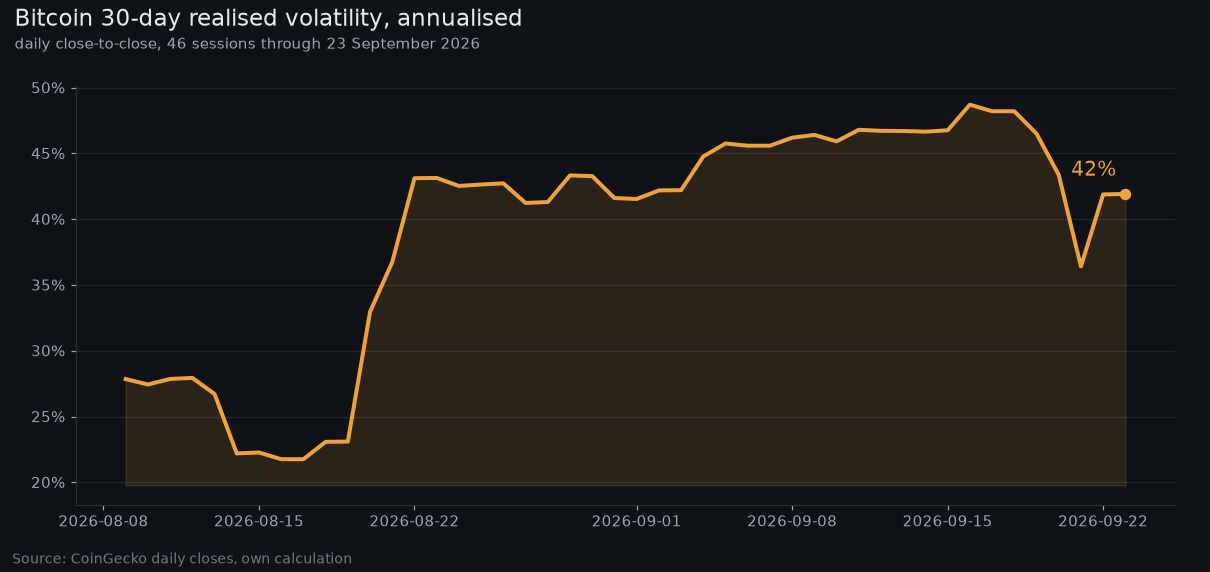
The volatility underneath that move is the part that deserves more attention than the price. Bitcoin's 30-day realized volatility, annualized from daily closes, is running near 42%. Over the past 52 weeks, the median has been 41%, the high 82% back in March, and the low 21.8%, set barely five weeks ago. Today's reading sits at roughly the 55th percentile of the past year. An asset that is supposedly a levered bet on the liquidity regime spent the week its chief input moved violently doing something it has always done in quiet regimes: nothing unusual. Then it expanded, to the upside, into a shock that was supposed to hurt it.
The case against all of this is easy to state and hard to dismiss. Nineteen observations is nothing. A correlation of -0.03 is equally consistent with no relationship and with a relationship that lags by weeks, and nobody can tell those two apart in real time. Bhatia's point about front-running is the strongest version of the objection: bitcoin has repeatedly moved before the liquidity that justified the move appeared, and a framework that is early is not the same as a framework that is wrong. If the Fed's own admission of an unsolvable supply problem eventually forces it back into accommodation, the red dot will have been early in the most profitable possible way.
The honest part is that what cannot be verified from here is which side of that claim is right; both sides are making a timing claim dressed up as a structural one. What can be said with the data in hand is narrower. The relationship that liquidity models depend on has not been visible at daily frequency for the past month, and the asset that is supposed to be its most sensitive expression is instead trading like a fixed-supply commodity during a period when supply is the headline problem.
Which brings it back to the Fed. If the binding constraint on the world economy is supply, then the assets that suffer most are the ones that need cheap money to survive — every borrower that has to come back to the market and ask politely for a new price on old debt. Bhatia's other worry this week was that somebody will not get a favorable roll in the fourth quarter. With the 10-year near 5% and the funds rate just raised into a supply shock, the arithmetic for the most levered balance sheets gets worse on a schedule that has nothing to do with sentiment. Bitcoin's answer to that problem is not that it rallies when liquidity arrives. It is that it never has to refinance. If that is what the market started pricing last week, the indicator blinking is not a malfunction. It is the message.