A 10-year gilt at 5.35 percent and a 1650s bread price list in three currencies describe the same thing: a unit of account is repriced in the long bond, long before anyone changes the price on a shop shelf. UK yields are the loudest version of the problem, and bitcoin against gold is where it shows up first.
26 Sep 20261,320 words · 6 minAlso on Nostr as a long-form note
On 14 September the ten-year gilt traded at 5.44 percent, the highest yield it has carried in this cycle. It closed Friday at 5.35 percent. That number is not a forecast or a sentiment reading. It is the price of lending money to the British state for a decade, and it has risen 1.12 percentage points since February, when the same bond yielded 4.23 percent.
The Bank of England's response was to stop selling its longest-dated gilts and shift the debt onto the Treasury's books instead. A central bank that declines to sell duration into the market is telling you something about the market. There is no natural buyer for it outside mandated pension funds, and the officials who set the price of money have stopped pretending otherwise.
That is the backdrop Nik Bhatia and James Van Straten built their latest macro conversation around, and their diagnosis is blunt: rate policy has become a lose-lose for governments. Raise rates and the interest burden on outstanding debt rises immediately. Cut them and you hand inflation another impulse. Either way the long bond has to find a buyer, and the buyer has to be convinced the number will still mean something in ten years.
Bread at three prices
Now put that next to a piece of history Cory Klippsten dug up, which at first glance has nothing to do with gilts. New Amsterdam, the 1650s. Merchants kept their books in guilders and stivers, but they settled in silver, beaver pelts, or wampum. By 1658 those media had drifted apart so far that a price expressed in guilders was incomplete information. The Director-General and Council fixed three prices for one two-pound loaf of white bread: four stivers in silver, six in beaver, eight in wampum. A barrel of good beer was ten guilders in silver, fifteen in beaver, twenty-two in wampum.
The Dutch had not invented this. They imported a habit that European merchants had used for centuries, keeping accounts in one unit while accepting every kind of worn, clipped, foreign coin at negotiated rates. The unit was the language. The coins were the delivery.
Klippsten draws the bitcoin lesson carefully, and his reading is more interesting than the standard one. The usual story says a medium of exchange comes first and a unit of account arrives later, once people already spend the thing. History does not agree. In high-inflation economies people have saved in a stronger foreign currency, priced houses and cars in it, and kept paying the grocer in the local money that was still depreciating. Russia in the 1990s went further: after cash dollar pricing was restricted, businesses quoted in "conventional units," which was a dollar by another name, settled in rubles at the posted rate. The scorekeeping changed before the payment behavior did.
So the ordering is not fixed. Store of value has to lead, because nobody spends hard money while soft money is still available to spend. What happens after that can go either way, in either order, at different speeds in different markets.
What a unit of account actually is
Strip the monetary vocabulary away and a unit of account is a promise about which numeraire you get repaid in. Every long-dated contract, every pension, every thirty-year mortgage is a bet on that promise. The market where those bets are priced is the long bond.
Which is why the gilt is the story. The Bank of England can set the overnight rate. It cannot set the ten-year yield, and this year it has been visibly losing that argument. Bhatia's framing: rates have led the Fed higher across the curve for months. Bitcoin appears to be enjoying the chaos, even though a plain liquidity framework says higher rates and higher volatility should damage risk assets.
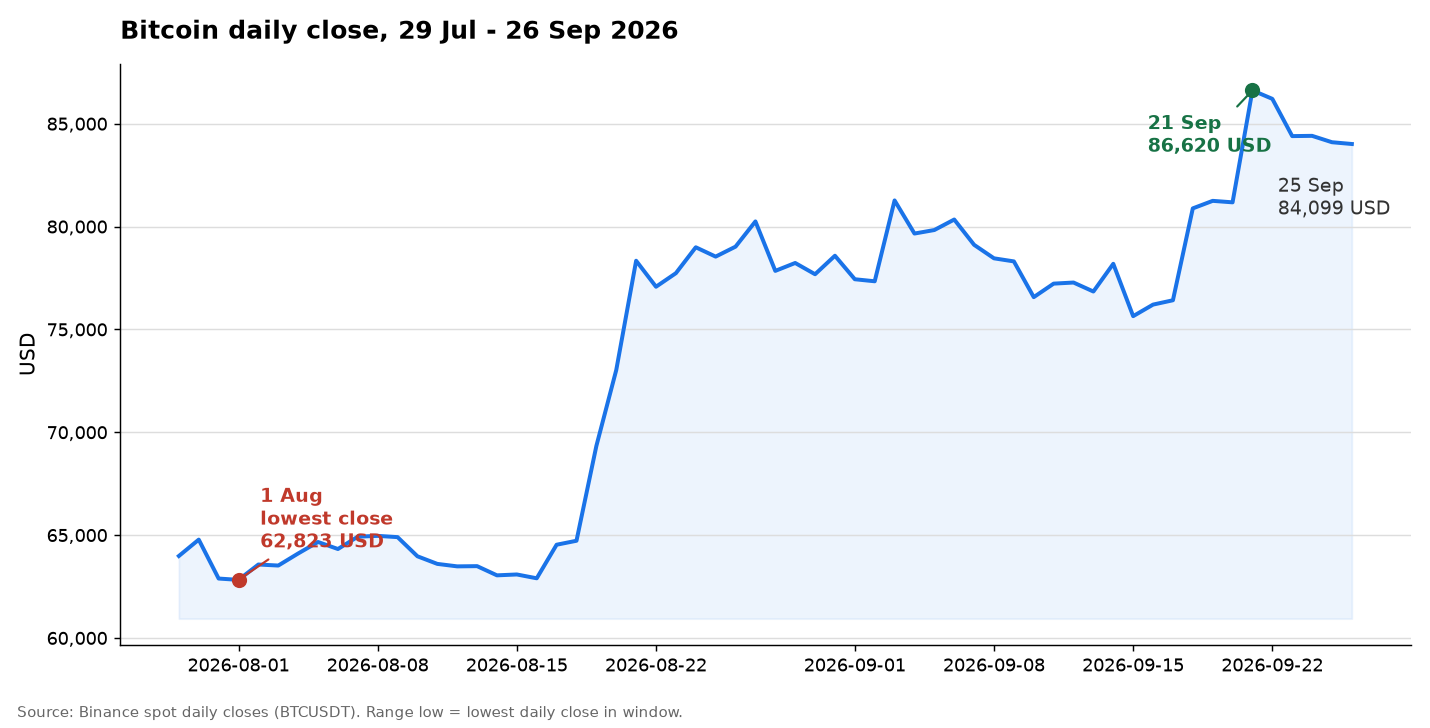
Bitcoin closed Friday at about 84,000 dollars, roughly 35 percent above its August low near 62,275 (Binance daily closes). Against gold at 4,286 dollars an ounce (gold-api spot, 26 September), one coin bought 19.6 ounces. It touched 20 ounces earlier in the run. Bhatia notes that Van Straten now watches bitcoin against gold more than against the dollar. That is the right instrument for this question. A dollar price can rise while purchasing power falls; an ounce of gold cannot be printed.
Bitcoin daily close, July to September 2026
The case against all of this
Here is the strongest version of the other side, and it deserves the space.
The dollar remains the unit of account for almost every wage, tax bill, and corporate debt on earth. That is not a decorative fact. Taxes are denominated in dollars, which means every firm's obligations are denominated in dollars, which means every firm's books are too. Network effects in accounting are brutally sticky, because changing your unit of account means restating every contract you have ever signed. Legal tender laws, tax liabilities, and debt covenants form a lattice that no asset escapes simply by being a better store of value.
And volatility is a real disqualifier. A unit that moves five percent in a week is a poor ruler. Nobody wants a mortgage denominated in something that can double or halve inside the term. The gilt problem is also, so far, a British problem: the US ten-year sits at 5.17 percent, uncomfortably high but with a functioning market and a global bid. Extrapolating from one country's fiscal mess to a monetary regime change is exactly the kind of leap that has embarrassed bitcoiners for fifteen years.
The counter is narrow and it holds. The dollar's grip comes from belief that the number will mean the same thing later, and that belief is priced continuously in the long bond. The US ten-year at 5.17 percent is not reassurance. It is the same arithmetic the gilt is working through, one step behind. A unit of account does not lose its status because a legislature votes it away. It loses it when the price of being repaid in that unit over long horizons stops being obviously cheap, and the people setting that price start buying gold and bitcoin instead.
What I could not verify
Two things stay open in this text. The gold figure is a spot quote from a single free source, so the 19.6-ounce ratio carries the error of that one price, not an official fix. And the claim that roughly 200,000 bitcoin left long-term holder wallets before the low came from Bhatia's own summary; I did not reproduce that on-chain measurement myself, so treat it as his reading rather than a number I confirmed.
One asset, three functions
Klippsten's closing observation is where this becomes concrete. Money scales in layers. A bitcoin economy does not require every coffee, payroll run, and loan to settle on the base chain. Credit and payment networks can sit above it, with their own risks and trade-offs, while everything above is still denominated in bitcoin and settles back to the same asset.
New Amsterdam had a common accounting language sitting on top of independent monies whose relative values moved constantly against one another. The bet bitcoin makes is the reverse: one asset performing all three functions, with layers above it that carry different risks but the same underlying unit. Save in it, settle in it, keep score in it, and the score cannot drift against the thing you are scoring.
Nobody announces a change of unit of account. It appears first in contracts, then in collateral, and only much later in price lists. Four hundred years ago a loaf of bread had three prices and the guilder still kept score. The question now is whether the ledger moves first or the wallet does. If the ledger goes first, the tell will not be coffee priced in sats. It will be a long bond that cannot find a buyer at any yield a finance minister is willing to sign.