Three lines are being drawn across Europe this year, and only one of them is on a ballot. A market repriced France above Italy without a vote. A central bank is waiting for permission to name the maximum balance a citizen may hold. A finance ministry has put a date on the end of the one-year tax exemption. Own data, own charts, and the Austrian reading of what the three have in common.
1 Oct 20263,943 words · 17 minAlso on Nostr as a long-form note
Three numbers are being set in Europe this year, and only one of them is on a ballot. A market decided one without asking, a central bank is waiting for permission to publish a second, and a finance ministry has put a date on the third. What connects them is not a shared policy. Each one draws a line where there used to be none — and in each case the line moves something that people had been treating as settled.
Start with the market, because it moved first and nobody voted on it.
The country that used to be the safe one
A bank counting hall before the doors open, photographed for this letter. Muted, empty, and about to price someone's debt.
For the whole life of the euro, French government debt has been the boring paper. Italy was the one that needed a risk premium. That is no longer true, and it has not been true for ten months.
On 1 October the ten-year French yield stood at 4.92 per cent against 4.69 per cent for Italy. France pays twenty-three basis points more to borrow for a decade than the country with the higher debt ratio, the worse history, and the government that has been through more crises than any other in the bloc.
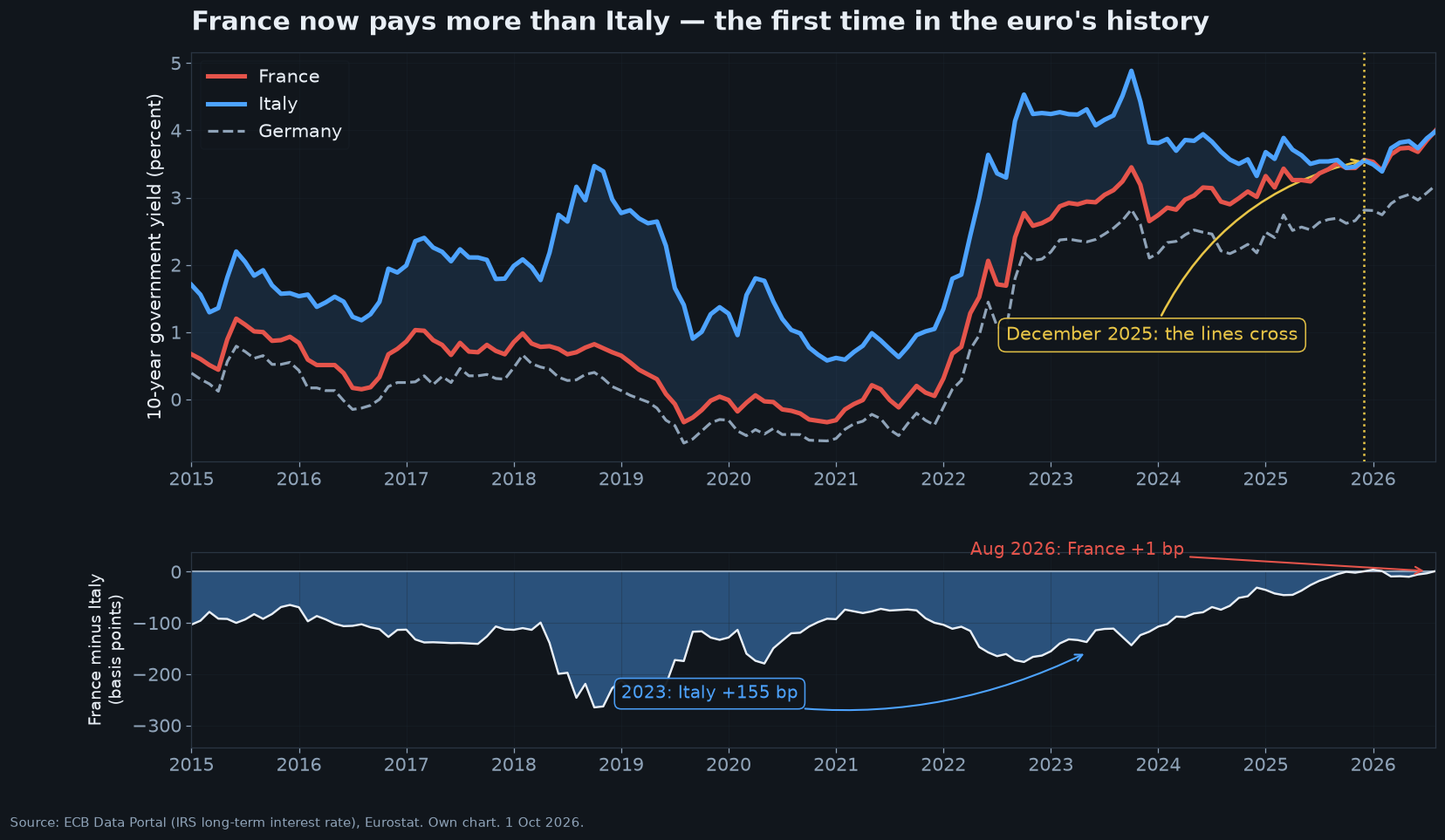
France against Italy, ten-year government yields, January 2015 to August 2026, with the spread below. Own chart, ECB series.
What matters is the long series. In January 2023, Italy paid 155 basis points more than France. Two years earlier the gap was 93, and in January this year the sign had flipped, and by August the ECB's own monthly series put France at 4.00 per cent and Italy at 3.99 — the first months on record with France above. The crossing happened in December 2025.
The market was not looking at the level of debt. France's debt is 117.6 per cent of output. Italy's is 138.9. If this were about how much is owed, the ranking would not have changed. It changed because of direction, and direction shows up in the deficit.
France closed 2025 with a deficit of 5.1 per cent of GDP. Italy closed at 3.1. In the first quarter of this year France's debt ratio rose 1.9 percentage points — the joint-largest increase in the union, alongside Poland. Italy's rose 1.8, from a base that would have frightened anyone a decade ago and no longer does.
Ratings followed the same path, later. In November 2025 Moody's raised Italy to Baa2 — its first upgrade of the country in twenty-three years. In January S&P moved the outlook to positive. The agencies were catching up to the market rather than leading it. In the euro's second decade the reliable debtor is the one whose numbers are improving. Size alone no longer decides it.
Nothing expresses it more cleanly than the spread. France's risk premium over Germany reached 132.86 basis points during the morning of 1 October, the widest since 2012, according to Reuters. By that evening it measured 140.6. Italy's premium stood at 116.4. In the summer of 2023 the relationship ran the other way by 155 points, and every euro-area model built in that period assumed it would stay that way.
The same day produced the answer to the obvious follow-up question. Asked whether the ECB might activate its bond-buying tool for France, Bundesbank president Joachim Nagel said the instrument exists to protect price stability. "It has nothing to do with maybe certain spread levels or things like that," he told Reuters on 1 October. The tool has never been used, and France is under an excessive deficit procedure, which makes an intervention hard to justify by the instrument's own criteria. Reuters reported that French ten-year yields that morning reached their highest level since 2002.
A line the legislator has to write down
That second number does not exist yet, which is the point.
The digital euro is intended to sit next to cash in a phone or a card. It has a holding limit. If the balance rises above it, the excess sweeps to a linked bank account automatically. Of the whole design, the limit is the only part ordinary people will actually feel, and it is the part nobody has agreed on.
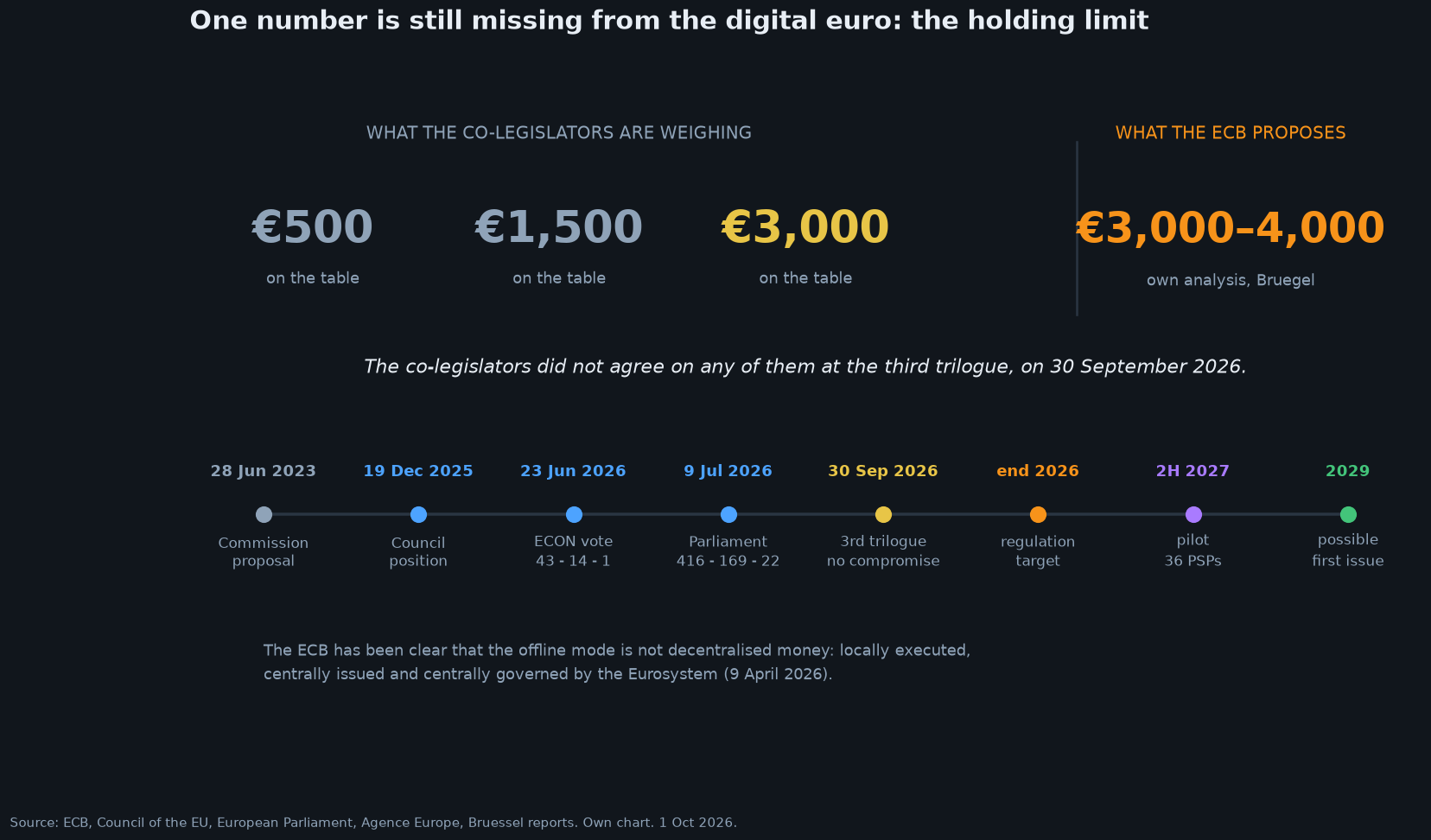
The holding limit options and the path from the Commission's proposal to a possible first issue in 2029. Own chart.Where it stood on 30 September, after the third political trilogue between the European Parliament and the Council: no compromise. The room where the number is being argued over. Negotiating documents are not public; the room at least is on the record.
Talks ran from early afternoon into the evening, covering the fee model for payment providers, the holding limits, and the legal tender status of cash. They ended without agreement on any of it.
No figure has been fixed. That sentence is the accurate one, and it is worth keeping in front of everything else here. What exists is a set of tested assumptions. The ECB's own financial-stability analysis examined hypothetical limits of up to 3,000 euros per person and concluded the digital euro would not threaten stability even in an extremely conservative crisis scenario. Testing a ceiling is not setting one.
The numbers circulating in the negotiation run wider. Reports on the talks, including the German financial daily Boersen-Zeitung, put 500, 1,500 and 3,000 euros on the table. An analysis for Bruegel describes the ECB's own suggested range as 3,000 to 4,000. Germany's federal data protection commissioner has described 500 to 3,000 as the live question. Each of those is a reported position rather than a decided number.
There is a second dispute running underneath the first, and it concerns who decides. Parliament's mandate has the Commission set the ceiling on an ECB recommendation and review it at least every two years, with Parliament keeping full decision-making power throughout. The Council prefers a Council implementing decision adopted by reinforced qualified majority, which keeps the choice with the member states. Both institutions agree a cap should exist. They do not agree on whose hand writes the number.
A gap running from 500 to 4,000 is no technicality. It is the difference between a payment instrument and a place where a household can hold a month's spending. That same number decides how much money leaves the banking system on day one. Retail banks across Europe have made their position plain. Their associations commissioned work from PwC that put the cost for savings and cooperative banks in the billions. The president of the German savings banks called the digital euro a door-opener for the large technology platforms.
Offline mode deserves its own paragraph. This is where the design stops being a payment question and becomes a political one. Offline payments would settle directly between two devices, with no internet connection and no third party seeing the transaction. The ECB describes this as cash-like privacy. Data protection authorities support it, and it is why members of the European Parliament from across the spectrum have argued for a privacy threshold on small payments. One proposal, from the Bavarian CSU, sets it at 100 euros per transaction. Another, from the left, asks for cash-equivalent anonymity.
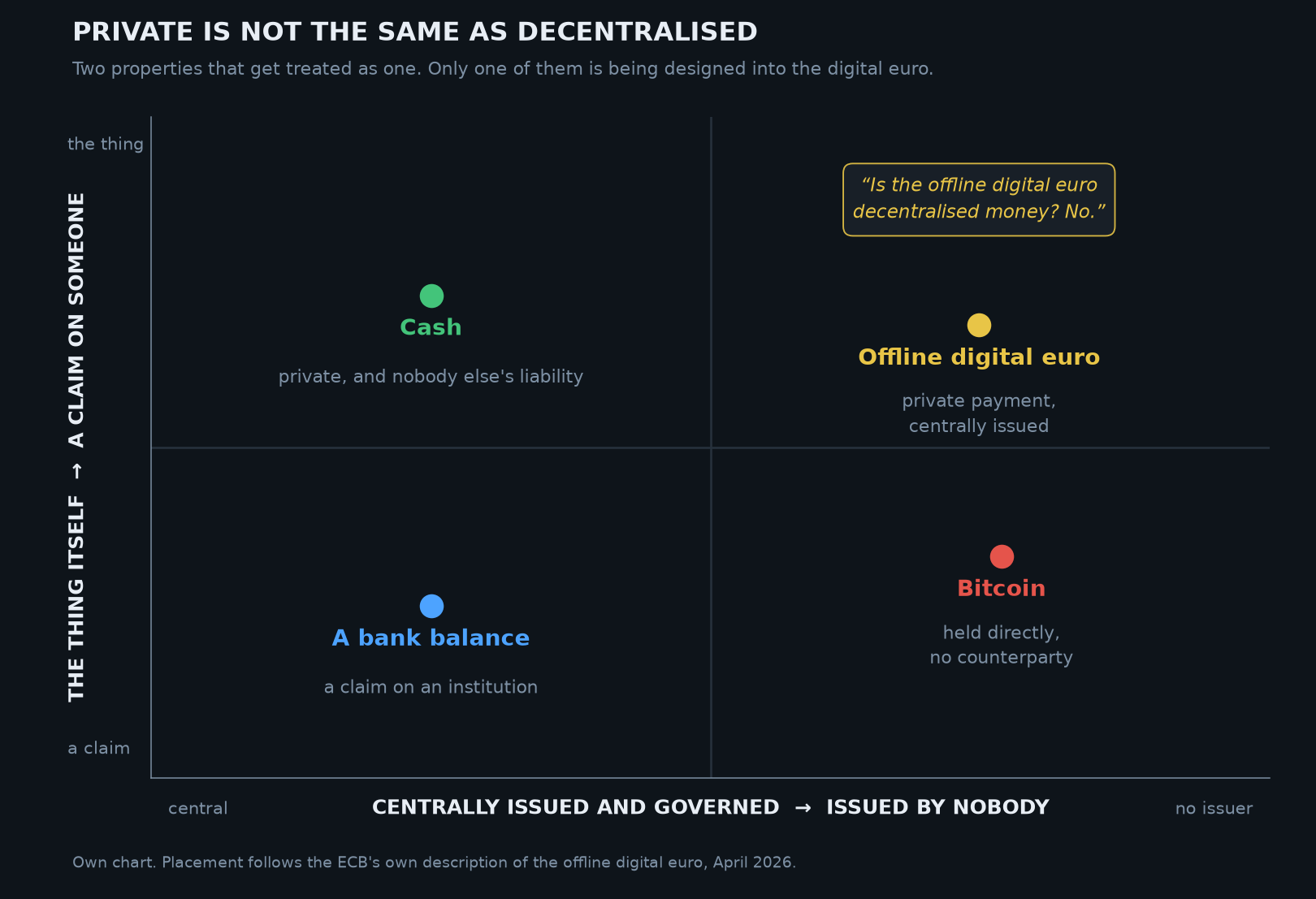
But the ECB stated the boundary itself, in an April 2026 presentation to the retail payments board, in a slide-and-answer format that leaves nothing to interpretation. One slide asks whether the offline digital euro is decentralised money, and answers in a single word: no. Even though the transactions happen locally, the offline digital euro is centrally issued and centrally governed by the Eurosystem.
That is the honest description, and it is worth reading twice. A payment can be private without the money being decentralised. Those two properties are independent, and only one of them is being designed in.
The timeline runs regardless. The Commission proposed the framework in June 2023. The Council settled its position in December 2025. The economics committee of the Parliament backed it 43 to 14 with one abstention in June 2026. The full chamber adopted its negotiating mandate on 9 July, by 416 votes to 169. The European Council set the target in March: a regulation by the end of this year. A pilot with 36 payment providers and selected merchants is planned for the second half of 2027 and would run twelve months. A possible first issue is 2029.
Two years between the law and the money, and a number still missing from the middle of it.
A date where there was a rule
The third line is the one that reaches German readers directly, and it is the only one that arrives as a deadline rather than an argument.
For private investors in Germany, bitcoin and other crypto assets are "other assets" under the income tax code. Sell more than a year after buying and the gain is tax-free, however large. Sell within the year and it is taxed at your personal rate, up to 45 per cent, with a 1,000-euro allowance per year and losses usable only inside the same category. There is a detail that catches people out more often than the rate: an exchange into another crypto asset counts as a disposal, and the clock restarts.
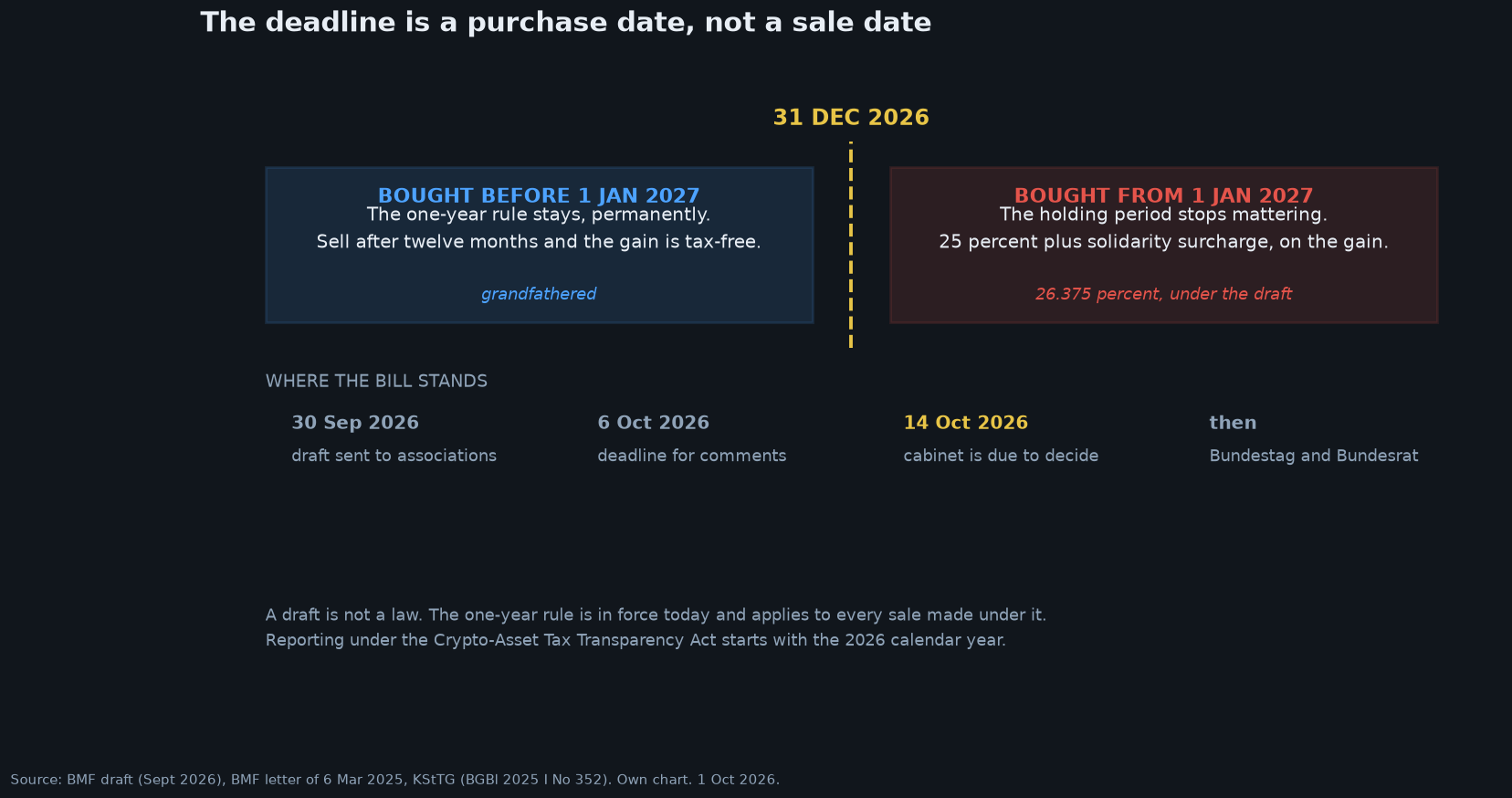
A draft now sitting with the finance ministry would end that, for new purchases. Gains would be treated as income from capital, taxed at 25 per cent plus the solidarity surcharge, 26.375 per cent in total. Staking and lending income would move into the same category. Non-fungible tokens, security tokens and crypto assets that convey a real right would stay under the old treatment.
The grandfathering cut-off and where the bill stands. Own chart.What concerns anyone holding coins is the cut-off. It is a purchase date rather than a sale date. Under the draft, the new regime applies to assets acquired after 31 December 2026. Everything bought before that keeps the one-year rule permanently. What happens in the last week of December 2026 is what the draft turns on: coins bought before the year ends keep the old exemption.
The practical consequence is blunt: coins bought in December 2026 carry a tax exemption that the same coins bought a month later will never have. Nothing about the asset changes. Only the calendar does.
Two further pieces matter more than they look. From January 2028 payment providers would withhold the tax at the source, the way banks do on capital income, with 2027 treated as the build-up period for the technical systems. Then there is the case where a provider does not know what the asset cost. That is common for coins moved from another exchange or held in self-custody. Here the draft allows a flat assessment base of 50 per cent of the sale proceeds. For someone who bought bitcoin years ago and cannot produce a receipt, that is no formality. Half the proceeds count as profit whatever the actual gain was, and in a flat year that exceeds the real gain outright.
That parliamentary route has already been tested once. A petition to keep the one-year rule, filed in late May 2026, gathered 44,277 signatures against a quorum of 30,000. It forces a public hearing. It does not force a vote, has no suspensive effect on legislation, and the Bundestag's own guidance says the number of signatures does not affect how a petition is examined. The comparison that should be drawn is the one the campaigners avoid: the 2009 petition against internet blocking collected 134,015 — three times as many — and the law passed anyway.
Separately, and already in force: the Crypto-Asset Tax Transparency Act. It entered into force on 24 December 2025 and implements the EU's DAC 8 directive and the OECD's crypto reporting framework. Reporting providers must report to the Federal Central Tax Office annually by 31 July, for the first time in 2027 covering the 2026 calendar year. Existing customers must be asked for self-certification by 1 January 2027.
Reporting collects nothing by itself. It changes what is knowable. And it is the part of this that is already law rather than a draft.
What an Austrian would say about all three
There is a reading of these three lines that does not treat them as separate stories, and it comes from a school of economics that spent the twentieth century arguing about exactly this.
The claim, in its shortest form: money is not a thing the state invents. It is a thing the market discovers. Carl Menger set it out in 1871 — a good becomes money because it is the most saleable thing available, and the process by which that happens is nobody's decision. Ludwig von Mises added the temporal half in 1912 with the regression theorem: the value of the money in your pocket traces back, link by link, to a good people valued for its own sake before anyone used it to trade. That is why the euro could be introduced on 1 January 1999 at a fixed rate against the currencies it replaced. It inherited a price structure. It did not have to discover one.
The digital euro is designed the same way. It is denominated in euro, pegged one to one, and inherits every price in the economy at the moment it exists. That is what gives it value on day one, and it is the honest answer to the question of why the ECB does not need to build demand from nothing. The interesting part is what that inheritance implies. The instrument is not new money in the Austrian sense, because it brings no new discovery. It is a new form of access to money that already exists, and it comes with a governance layer the existing form does not have.
The holding limit is where the Austrian critique lands hardest, and it is worth seeing why. The number on the table is either 500, 1,500 or 3,000 euros, and no single figure is right. Whatever it settles at, it would be one administrative judgement applied to 353.2 million people, the Eurostat count for the twenty countries that would use it. Their precautionary needs, income rhythms and savings habits differ in ways no office can pre-aggregate. Hayek's point in "The Use of Knowledge in Society" was exactly this: the relevant knowledge is dispersed, local and often not articulable. A planner can set a number. What a planner cannot do is know what number the circumstances require.
Set against that, the German tax change looks like the opposite kind of intervention. It does not govern what money can do; it changes what holding it costs. And here the Austrian frame is blunt about the stakes. Capital gains taxation on an asset is not neutral among outcomes: it taxes the gain in nominal terms, so a holder who merely matched inflation still owes tax on a gain that was never real. Under the draft, the exemption for holding for a year is replaced by a rate of 26.375 per cent, and where the acquisition cost cannot be produced, half the proceeds are treated as profit regardless of what actually happened.
Bitcoin sits on the other side of all three lines, and it is worth being precise about how.
Safe deposit boxes: the older answer to holding value outside a bank's ledger.
Every currency in circulation today is, in the Austrian vocabulary, either state money or a claim on something. A bank balance is a claim on a bank; a stablecoin is a claim on an issuer. Bitcoin is not a claim on anything. It is the thing itself, held directly, with no counterparty who must perform — which is a different property from being private, and the two get confused constantly. The ECB said as much from the other direction when it answered its own slide question: the offline digital euro is centrally issued and centrally governed. A payment can be private without the money being decentralised.
Private is not the same as decentralised: cash, a bank balance, the offline digital euro and bitcoin placed by who issues them. Own chart.
None of that makes bitcoin money in the sense the euro is money. It is not a unit of account for wages, contracts or taxes. The honest version of the Austrian argument, and the one its own literature is still arguing about, is that bitcoin solves the problem of issuance and leaves the problem of adoption open. The regression theorem says a medium of exchange must inherit a price structure. Bitcoin's answer is that it built one from zero over seventeen years, which is either the most interesting thing about it or a very long way of proving that this takes a long time.
What the three European lines have in common, seen from this angle, is that none of them changes what money is. A market repriced a sovereign. A legislator is choosing a number. A ministry set a date. Each one changes the terms on which existing money may be held, and each one is a decision taken by someone other than the person who will live with it. The Austrian objection is not that these decisions are wrong. It is that they are decisions, and that the alternative — a money whose terms nobody sets — has never been available at scale until recently.
That is where the numbers actually are today. On 1 October a bitcoin cost 84,375 dollars, which was 75,187 euros. The whole market was worth 1.70 trillion. Block height stood at 969,467. Fees were 7 satoshis per vbyte, and the next difficulty adjustment was due in 229 blocks. Seventeen years old, and still not a unit of account for anything.
The case against all of this
The strongest argument against treating these three as one story is that they are not one story, and the reader should be suspicious of any writer who lines up three unrelated facts and calls the arrangement a pattern.
French-Italian spread is a market price, and market prices move back. It moved out of nothing more dramatic than a budget fight and a frozen pension reform. France has not defaulted, has not been cut to junk, and still borrows at a rate the United States pays more than. Italy's improvement rests partly on inflation that flattered its debt ratio and on a primary balance that is not large. If France passes a credible budget in the next year, the spread compresses and the story evaporates. Spreads have reversed before, repeatedly, which is the entire reason bond desks get paid.
Nobody would be obliged to use the digital euro. Cash is not being abolished — the Commission proposed a companion measure specifically to protect its legal tender status, and the ECB's own material says the digital euro complements cash rather than replacing it. Whatever the holding limit settles at, it exists precisely so that the instrument does not drain bank deposits; the argument is about calibration rather than direction. Central governance is a property of every currency in existence, including the notes in your wallet. The offline mode is not a concession that was wrung out of reluctant central bankers; it is in the design because data protection authorities demanded it.
A draft is not a law. This one comes from a ministry that has already lost a fight over its own budget, and the cabinet date has slipped. Parliament has no room left for a full reading before the start of next year. Germany has changed capital taxation before and changed it back.
On bitcoin, the Austrian reading is the part most open to challenge, and its own school knows it. Mises' regression theorem is not a prohibition — it describes how a medium of exchange learns its value, and the argument inside Austrian economics is whether bitcoin satisfies it or quietly refutes it. The practical objection is simpler and harder: seventeen years in, bitcoin is still not a unit of account for wages or contracts anywhere, and "not yet" has been the answer for most of that time. The claim that nobody sets its terms is also not quite true. Somebody sets the terms of access: the exchanges that gate entry, the custodians that hold most of the supply, the regulators that decide whether a bank may touch it. Self-custody is real and it is not the default. A holder who uses a custodial wallet is holding a claim, and the Austrian framework says so more clearly than the marketing does. A grandfathering clause is itself evidence that the government knows it is altering a promise people relied on, which is not what a confiscation looks like.
The honest version of the counterargument is this: three separate facts, three separate causes, and a writer with a deadline who found the pattern more interesting than the difference.
Where it does hold, and where I could not check
Three countries, three mechanisms, one property: each of these lines moves a boundary that people had treated as fixed, and none of them was drawn by the people who will feel it.
In France the boundary moved without a vote. A sovereign that had been treated as core was repriced, and the ratings followed. In Brussels the boundary is subject to a negotiation in which the number itself is the subject, and the number is somewhere between a payment and a savings account. In Berlin the boundary is a date, and a date is the cruellest form of a rule, because it requires nothing of you except attention.
The thread running underneath all three is the same, and it is not political. It is that the cost of holding value is being reset everywhere at once. Real yields have finally turned positive. A central bank is designing a digital claim it will govern. A state has decided the exemption for patient holding is no longer affordable. Bitcoin is not the subject of this letter. It is the instrument that sits outside all three lines, and the reason it does is not technical. Nobody can set a holding limit on it, put a date on its exemption, or reprice the sovereign that stands behind it, because no sovereign stands behind it.
What I could not check. Figures of 500, 1,500 and 3,000 euros come from press reporting on the negotiation, including the Boersen-Zeitung; the underlying negotiating documents are not public, and the trilogue outcome I describe comes from Agence Europe's bulletin rather than from a published text. A Bruegel range of 3,000 to 4,000 is an analysis of what the ECB proposed. The proposal itself is not public. The PwC cost study for the savings and cooperative banks was commissioned by their associations. What I have read is the association's summary; the study itself I have not seen. On the tax side, everything attributed to the draft comes from reporting and law-firm analysis of a text that has not been published; the ministry's own website did not carry it as of 13 September. Those 44,277 signatures are as recorded on the petition platform on 13 September and the count has since closed. The 50 per cent flat assessment base, the 2028 withholding start and the treatment of staking income are all from analysis of the draft and could change before the cabinet meets. The French and Italian deficit and debt figures are from Eurostat and are as reliable as official statistics get, but this year's numbers will be revised.
Yields here are measured rather than quoted: ECB long-term interest rate series and a live quote from 1 October 2026, both in the chart.