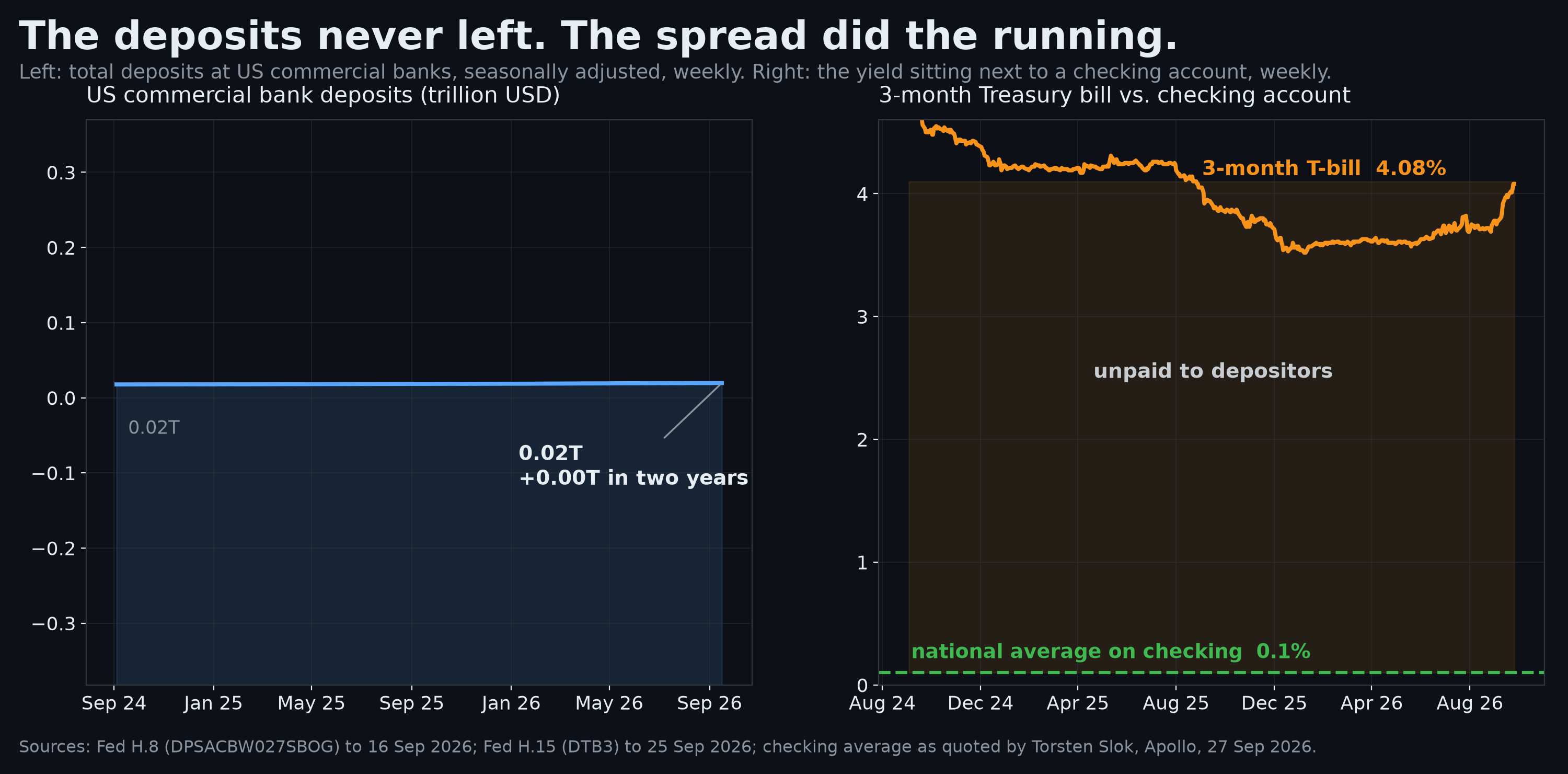
Torsten Slok warned AI agents could trigger a bank run by sweeping cash out of near-zero checking accounts. US commercial bank deposits grew by 1.19 trillion dollars over the same twelve months. The money never left the system; the spread did the running.
29 Sep 20261,067 words · 5 minAlso on Nostr as a long-form note
On 27 September Torsten Slok, chief economist at Apollo, published two short paragraphs about a bank run. An assistant like Muse, he wrote, "could soon sweep household cash automatically into accounts paying 3.3% to 5.0%, instead of the 0.1% national average on checking accounts." If every household did that, banks would lose the cheap deposits they lend against. Slok called that a problem for the entire financial system.
The letter travelled fast and the doom travelled faster. Anthony Pompliano answered it within a day, and his answer is the one worth reading. Both sides argued on the same assumption though, that the deposits leave. Nobody opened the deposit file.
Total deposits at US commercial banks, seasonally adjusted, stood at 19.568 trillion dollars in the week ending 16 September 2026, according to the Federal Reserve's H.8 series. A year earlier that same line read 18.377 trillion. The deposit base grew by 1.19 trillion dollars across the twelve months in which the fear was forming. The money sat where it was. What changed is the price it should have been earning.
Two panels. Left: US commercial bank deposits, seasonally adjusted, 18.38 to 19.57 trillion dollars between September 2024 and 16 September 2026. Right: the three-month Treasury bill at 4.08 percent against the 0.1 percent national average on checking accounts. Own chart, Federal Reserve H.8 and H.15.
The cheapest funding in finance
A checking account pays almost nothing because the customer does not shop. That inattention is the product, and it is worth roughly four percentage points a year. The three-month Treasury bill closed at 4.08% on 25 September 2026 in the Fed's DTB3 series, while Slok puts the national average on checking at 0.1%.
The gap is not a discovery of the AI era. The same bill yielded 3.86% in late September 2025 and never once fell below 3.53% on a monthly average after December. The spread has been quoted on a screen every morning for years, and deposits still grew. Whatever holds money in a 0.1% account, it is not the absence of a better offer.
Cullen Roche made that argument within hours of Slok's note. "When cash moves from a checking account at Bank A to a savings account at Bank B, Bank A's deposits fall and Bank B's deposits rise by the same amount," he wrote. "The money never leaves the system. It just changes addresses." He is right about the plumbing, and the plumbing matters more than the alarm. Deposits that flee one bank land in another, or in the partner bank standing behind a fintech, with the system total unchanged.
Roche added the sentence that ought to close the discussion. "That's a real cost, but it's a cost, not a collapse."
The version that does hold
The strongest form of the worry is not silly, and it deserves a fair hearing. Silicon Valley Bank was a run from one bank into other banks. Deposits never left the system then either, and the bank still died inside two days. Speed is what killed it. If an agent can move uninsured balances in minutes rather than days, the weakest liability books lose their defence before a human picks up the phone. Stickiness was never only a pricing subsidy. It was what allowed a bank with a mismatched balance sheet to wait out a bad month.
That is a real risk for specific institutions, and it is a transfer that cash holders will enjoy. The money runs from bank shareholders and their net interest margin toward anybody holding a dollar. A world in which deposits are always quoted is worse for bank equity and better for savers, and those two facts usually get reported as one.
What actually changes
Agents do not invent the incentive. They remove the transaction cost sitting on top of it. An economy is full of money parked at a bad rate purely because moving it asked for an afternoon of forms. Marty Bent drew the useful distinction: dollars become the hot layer, "useful while a transaction is in motion, held for as little time as the business can manage." Haseeb Qureshi was blunter about whose business that ends. "Business models built on friction and human laziness will (rightly!) get slaughtered in the coming years."
The saving layer is a different question, and it does not answer itself with a yield. If an agent sweeps your cash into a five percent dollar account, you still own dollars, and the number of dollars in existence is a policy variable. A rate on a unit is a fact about the unit. It says nothing about what the unit buys when you spend it.
There is evidence that some of this money has begun to look past the rate. US spot bitcoin ETFs took in 2.39 billion dollars net in the week of 21 to 25 September, per the tracker in TFTC, the first multi-billion week since the October 2025 high. Check Onchain reports roughly 2.1 billion for the same week, and I cannot tell from outside which window each is counting. Either way, brokerage money came back while the spot price spent the year falling. Bitcoin traded at 112,179 dollars on 29 September 2025 per CoinGecko, and at 83,958 dollars this morning on mempool.space's feed.
What I could not verify
Four numbers here are attributed rather than settled. The 0.1% national average on checking and the 3.3% to 5.0% range belong to Slok; I did not independently audit the FDIC series behind them. The deposit figures are seasonally adjusted weekly readings with a lag, one week old at the time of writing. The ETF totals disagree by roughly three hundred million dollars between two trackers. The price readings are single-source snapshots from free endpoints taken this morning.
Slok asked whether agents can empty the banks. The file says the money stayed, and the spread did the running. A queue outside a branch is not the thing to watch. Watch how fast the short end of the curve reprices when millions of identical optimisers read the same screen each morning. Then ask whether an economy that prices its money every second can still hold anything it does not plan to spend. An agent with a one-year memory would have chosen the bill over the coin. The mechanism is real. The timing is not ours.