The Squeeze That Reprices Itself
Bitcoin miners absorbed a quarter price drop with an automatic adjustment no manufacturer gets. Two charts, 240 measured blocks, and the fee line that will not save them.
Bitcoin miners absorbed a quarter price drop with an automatic adjustment no manufacturer gets. Two charts, 240 measured blocks, and the fee line that will not save them.
Two documents crossed my screen this week. One is a Texas manufacturer explaining to the Dallas Fed that it now builds diesel at six dollars a gallon into every bid, because it has no other option. The other is Cory Klippsten's essay on the six games of Bitcoin, which opens with miners and ends with nation-states and treats every one of them as a game people choose to play.
Both describe the same event. Inputs cost more, customers refuse to pay more, and the operator in the middle eats the difference. The Dallas Fed published the arithmetic. Raw materials prices rose to 52.2 in its September survey against a series average of 28.0, finished goods prices to 27.6, wages to 27.4. Marty Bent put the two relevant lines next to each other: input price growth of 4.9 percent over twelve months against selling price growth of 3.0. A hundred and ninety basis points of margin, gone, every year, with no lever on either end.
Bitcoin's mining industry lives inside the same trap. It differs in one respect, and that difference is worth the whole essay.
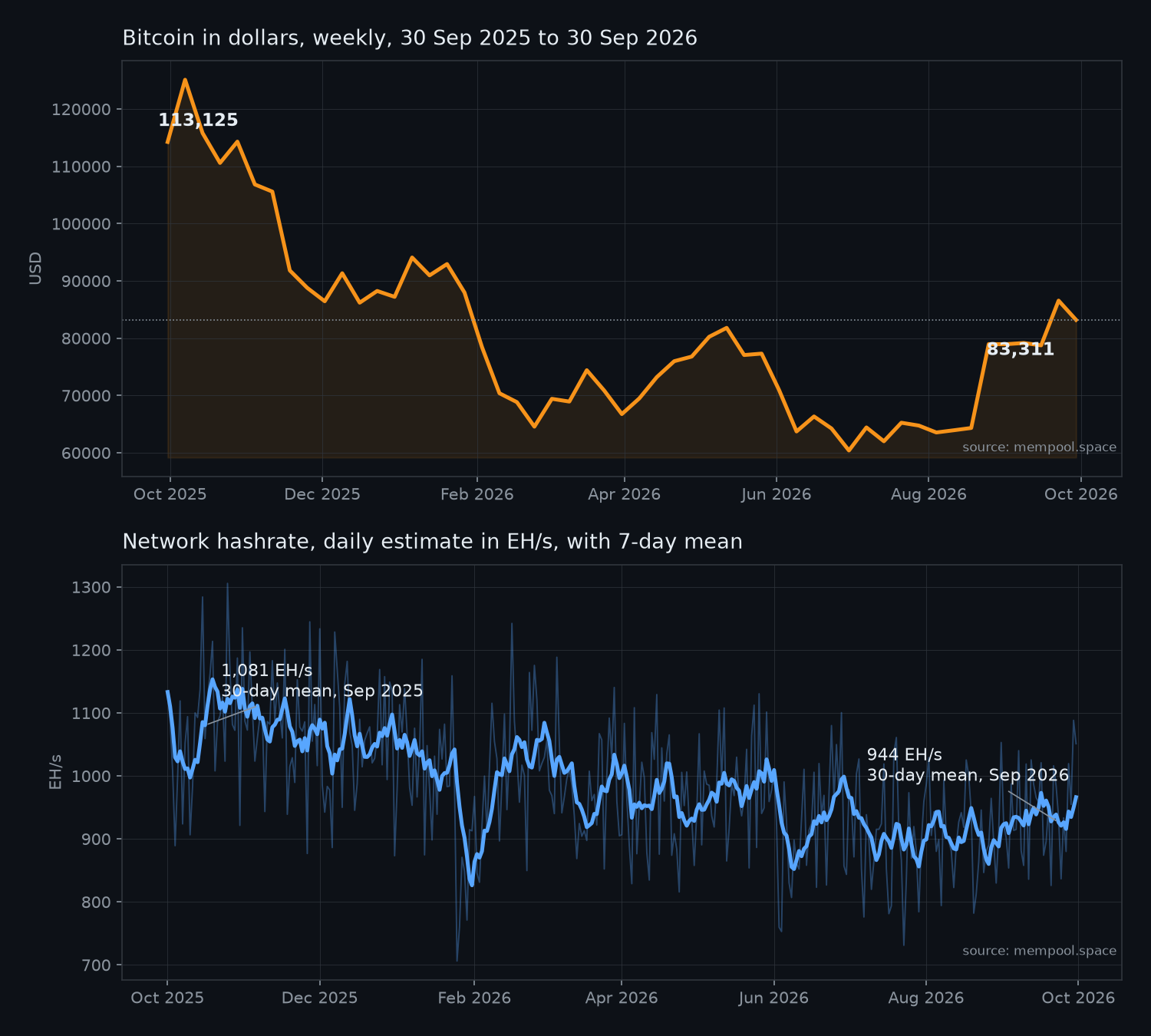
Bitcoin traded at 83,311 dollars this morning on mempool.space, against 113,125 dollars on 30 September 2025.
The hashrate did not hold still. Thirty-day average hashrate ran at 944 EH/s as of 30 September, against 1,081 EH/s a year earlier. Network difficulty, which is the protocol's own settled measure rather than an estimate from block times, stood at 133 trillion on 19 September against 151 trillion a year before. Peak difficulty in the window was 156 trillion in late October 2025.
There is no committee in that number. Klippsten lays out the miner's game cleanly. Expanding pays until every competitor expands too. Then the difficulty adjustment hands everyone back the same share of the same issuance, with twice the capital sitting in the field. What he describes as the cost of cooperation is also, read the other way, a cost that reprices itself. Hashrate leaves, blocks arrive slower, difficulty falls, and the machines still plugged in collect more per unit of work. Nobody voted. Nobody wrote a comment letter. The network simply paid less for the same blocks, and the operators who could not survive it stopped.
Now read the Texas survey as the control group. Its production index jumped thirteen points to 29.5, the strongest reading since July 2021. Capacity utilization hit 23.9 and new orders 30.7. Every backward-looking number says boom.
The forward-looking ones say something else. The outlook indexes went the other way. The company outlook reading fell to 8.7 from 19.2, and the measure for expected business activity dropped to 20.8 from 37.2. A machinery manufacturer described running flat out on a backlog built at prices agreed months earlier. That is the pattern behind the strong headline. Backlogs clear, and capex that does not happen this year is capacity that does not exist in three.
The respondents named the reasons. One nonmetallic mineral producer is bidding work at a diesel assumption of six dollars a gallon. A beverage and tobacco manufacturer said customers had hit their limit and cancellations had started. A printing firm traced the paralysis to Washington, where the rules change mid-contract. A static tariff can be priced into a quote. A tariff regime that can be rewritten after the quote cannot.
The structural difference is that a manufacturer cannot do what a miner does. A shop building thirty-year plant cannot cut its cost curve by unplugging. It cannot move a kiln to cheaper power, and it cannot wait for an automatic adjustment that spreads the pain across every competitor. It absorbs the spread until equity runs out. Bitcoin has no such institution, which is exactly why its industrial base is repriced without a bankruptcy wave.
A fair reading has to say where this mechanism fails, and I could not verify a version of the story in which it fails nowhere.
Difficulty protects the ledger, not the miner. It rebalances blocks every 2,016 of them, so losses can run for two weeks before help arrives. The help arrives as a higher share for the machines still running, not as a softer rule for the ones that quit. Nobody owes a miner a margin. The rule is indifferent to which machines switch off, and a network where the adjustment does the work will always have some operators for whom the answer was to leave.
The fee side is the harder problem. I sampled 120 consecutive blocks from the end of September, heights 969,092 through 969,274. Total fees came to 2.338 BTC against a subsidy of 377.34 BTC, or 0.62 percent of the reward paid out. The same window a year earlier ran 0.55 percent. Meanwhile block weight utilization rose from 86.3 percent to 98.6 percent, and the effective price of the space hardly moved at all, at 1.98 satoshi per virtual byte against 1.99 a year ago.
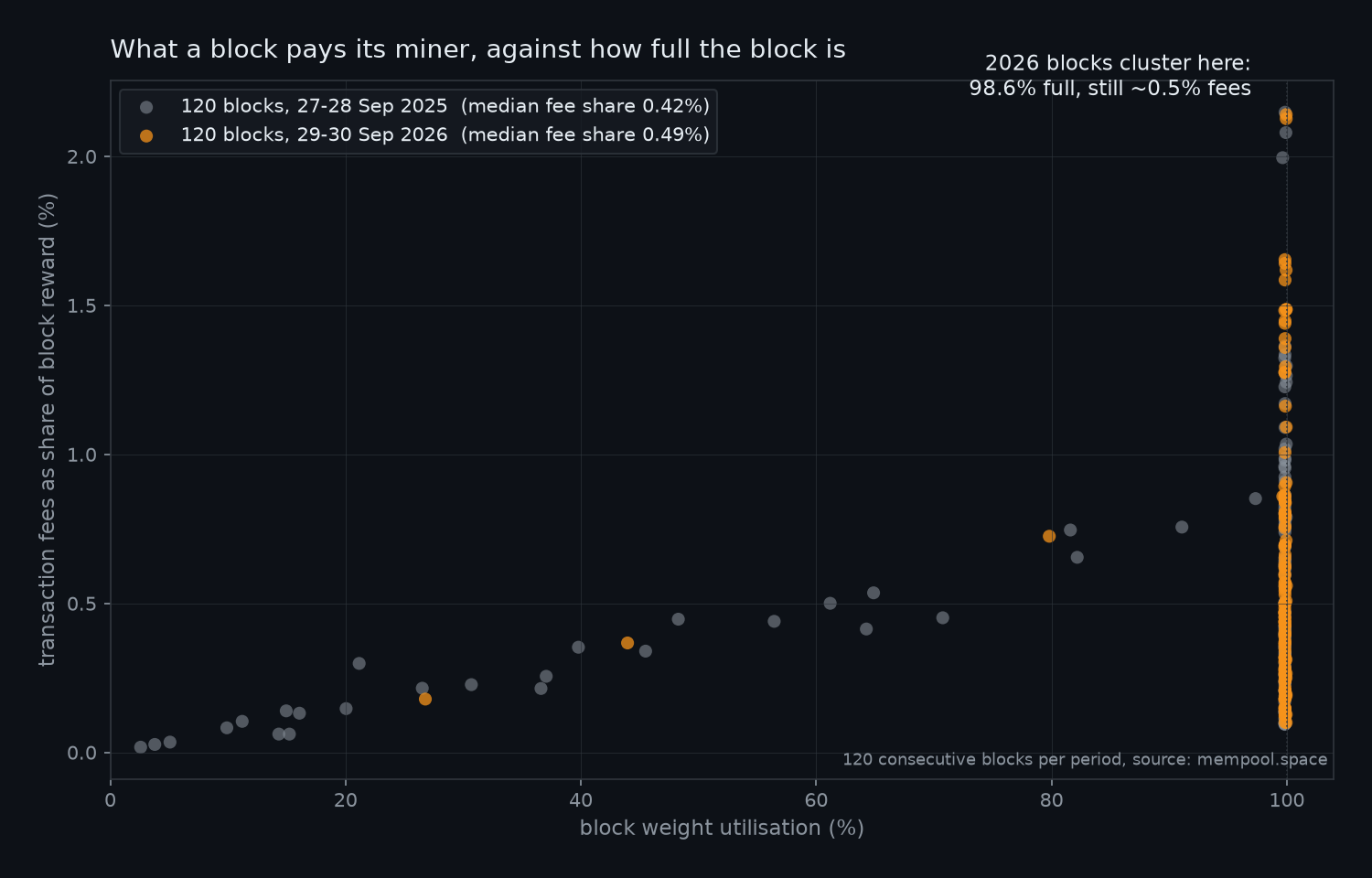
Read those together. Blocks are close to full while space costs about one satoshi. The subsidy halves at block 1,050,000, roughly 560 days out, and if fees stay anywhere near current levels they will fund about 1.25 percent of the reward at that point. The mechanism that lets miners leave quietly is the same one that would let them leave and not come back.
The concentration Klippsten flags in his second game shows up in the same data. Over the last 1,037 blocks Foundry USA mined 24.9 percent, AntPool 21.9 percent and F2Pool 15.3 percent. Three pools, 62.1 percent of the chain. Independent operators choosing the most predictable payout have handed block template control to a handful of firms, and their only exit is to redirect machines, which is easy and rarely happens.
The hashrate figures are mempool.space's estimates from difficulty and block intervals, not a count of machines. The Dallas Fed numbers are from the September release on 28 September, collected 15 to 23 September from 63 of 113 surveyed firms, and the 190-basis-point spread is Marty Bent's subtraction of two reported series. The price readings are single-source snapshots. Whether difficulty falls again at the next retarget is unknown; mempool.space projected a change of 0.6 percent with 421 blocks remaining at the time of writing.
A manufacturer absorbs a spread because its capital is bolted down. A miner absorbs one because he chose a network that rebalances his income without asking him, and because unbolting the capital is the one option the protocol cannot take away. The interesting question is not whether miners earn a healthy margin. It is what gets built in a decade where one industry can absorb a cost squeeze automatically and every other industry waits for a central bank to deliver that same consequence by hand.