Two US votes in one week: a 20-year statutory lockup on seized bitcoin, and a failed cloture vote the day before. What a legislature can bind, and what it can only chase - read against the price ceiling nobody can enforce.
27 Sep 20261,295 words · 6 minAlso on Nostr as a long-form note
On 16 September the House Financial Services Committee voted 28-21 to report H.R. 8957 to the floor. It is the first Strategic Bitcoin Reserve bill ever to clear a full committee, and the first time the American legislature has put a bitcoin bill on a procedural path rather than a press release. The bill orders a twenty-year statutory lockup on every coin the federal government already holds from forfeiture, plus quarterly proof-of-reserve reports with cryptographic attestation. It authorizes no purchases.
One day earlier the Senate failed to advance the CLARITY Act, 49-50, short of the sixty votes required. No Senate floor vote for ARMA has been scheduled.
Two votes in one week, and on first read they cancel each other out. Read together, they describe something narrower and more useful: Congress will bind its own discretion long before it will bet on an outcome it cannot control. The same lesson arrived the same week from Cory Klippsten, writing about politicians who promise cheaper bread.
What a lockup actually does
The Strategic Bitcoin Reserve already exists. It was created by executive order in March 2025, which means it can be unmade by a pen stroke in January 2029 or any January after. ARMA's contribution is not the coins. It is the friction.
A statute moves the default. Under an executive order, an administration sells seized bitcoin because nobody has to stop it. Under ARMA, an administration has to affirmatively schedule a disposal, publish proof of what it holds every quarter, and defend both in public. That is what statutory commitments are for. They do not make a decision impossible. They make it expensive to make quietly.
Which is why the least discussed provision deserves the most attention. The bill mandates a public accounting with cryptographic attestation precisely because none exists. There is no official Treasury proof-of-reserve today. Figures circulating in secondary coverage are unconfirmed, and the holdings themselves remain subject to ongoing legal claims. Congress is voting to lock for twenty years a pile whose size no one has certified. That is not a flaw in the bill. It is the clearest evidence of how discretionary the current arrangement is.
The strongest case against it
A statute is not a constitution. The next Congress can repeal ARMA with fifty-one votes in the House, sixty in the Senate, and a signature, and the twenty-year clock resets to zero. Anyone treating a statutory lockup as a permanent property right is confusing legislation with amendment.
The bill also buys nothing. It holds what was seized. The BITCOIN Act, which would direct Treasury to accumulate up to a million coins over five years, has not received a committee hearing in either chamber. And the executive-order reserve has been treated by the Treasury Secretary as a custody arrangement rather than an accumulation program since August 2025. ARMA changes none of that.
The counterargument survives anyway, for a reason that has nothing to do with bitcoin. The value of a statutory hold is not that it is unbreakable. It is that breaking it becomes an event. A repeal requires a public vote with names attached, after years of published quarterly attestations. Discretion costs a signature. Reversal costs a record. In monetary policy, that difference is most of what law can deliver.
The €2 tomato
Now the second vote, which was not a vote at all.
Klippsten's argument is about a different kind of statute: the one that fixes a price. A government can dictate a maximum legal price and punish anyone who trades above it. What it cannot do is legislate away the scarcity, the cost of production, and the preferences that produced the market price in the first place. The legal number changes. The shortage does not.
Germany in June 1948 makes the mechanism visible. Prices and rationing had been fixed for years, official numbers had detached from what people would trade at, and barter had replaced the monetary economy. When the Allies introduced the Deutschmark and Ludwig Erhard freed most prices, goods appeared in the shops almost immediately. They had not been manufactured overnight. They had been sitting in inventory, waiting for a price that told the truth.
That is the whole argument, and it is an argument about information rather than fairness. Hayek's point was that the knowledge needed to allocate resources is scattered among millions of people and cannot be collected in one place. A rising tomato price in Helsinki tells a wholesaler to search farther away without explaining the Spanish harvest. A ceiling of two euros transmits nothing except a prohibition, and the shortage simply changes address: queues, rationing boards, black markets, and goods that stop being produced. Klippsten's line is worth keeping. Markets discover prices; governments dictate them.
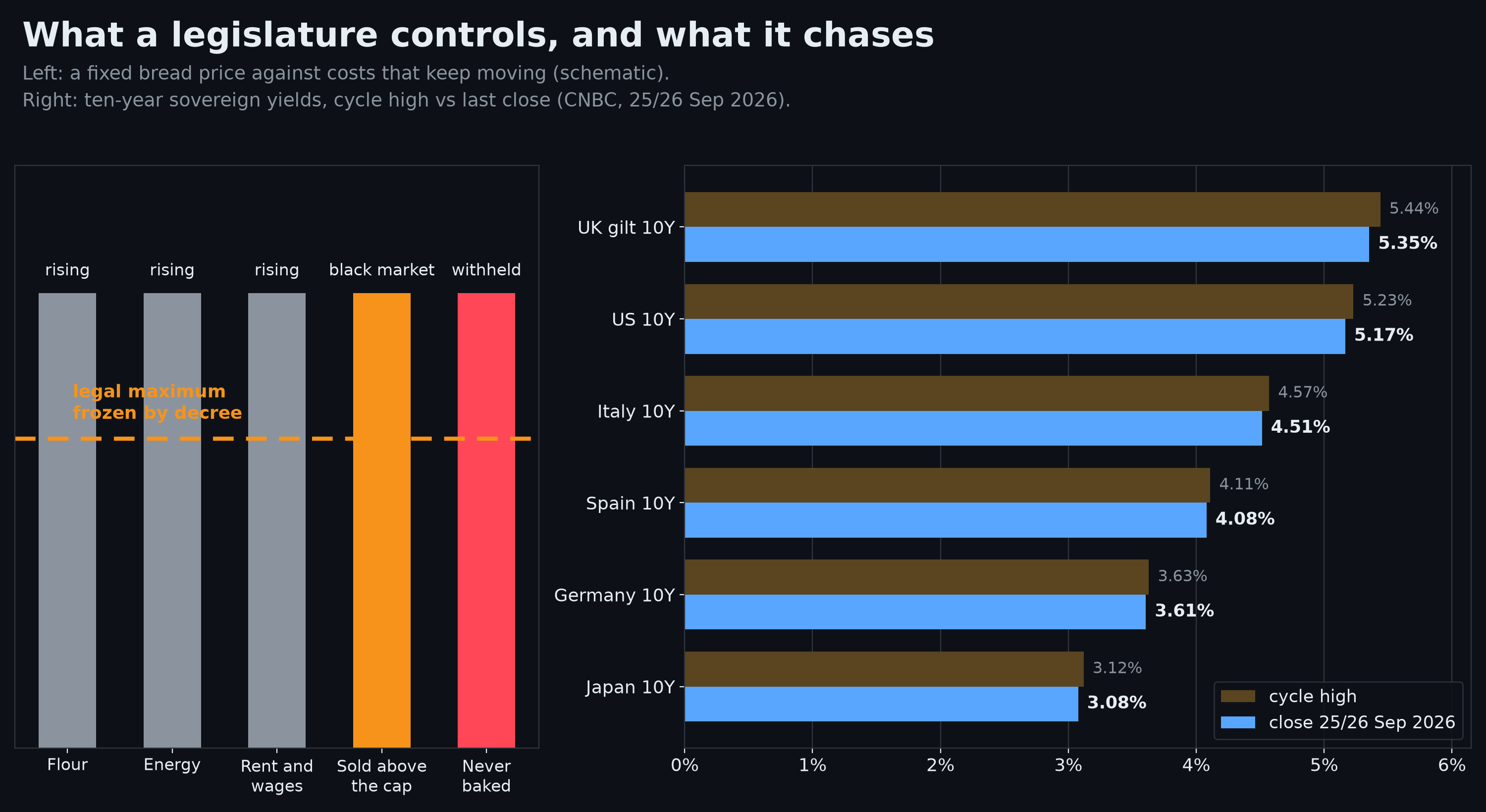
Turkey's bread tariff is the slow-motion version. The maximum loaf price moves through an administrative committee while flour, energy, wages, and rent move on their own. When the official number falls behind, bakers ask for increases, some sell above it, the state subsidises flour, and the tariff moves again. The committee cannot determine the economics. It chases them.
San Francisco shows what happens when the price is held for decades rather than months. The 1994 expansion of rent control held rents down for sitting tenants, who then moved less often, and landlords reduced the rental stock by about fifteen percent, mostly by selling or redeveloping. The tenant who kept the cheap flat can see the benefit. The renter who never found the apartment cannot see the cost.
The same instrument, two grips
Left: a fixed bread price against costs that keep moving. Right: ten-year sovereign yields, cycle high vs last close.
Put the two halves of this week together and the shape is clear. Both are legislatures reaching for a number they do not produce. ARMA grabs the one variable a legislative body genuinely controls: its own future willingness to sell. A price ceiling grabs an equilibrium that exists outside the building and outside the country, and the grip slips exactly where the shortage is worst.
The bond market prices this distinction every day, and it is not pricing reassurance. The US ten-year closed Friday at 5.165 percent, having touched 5.23 percent in the same session, its high for the cycle, with the two-year at 4.86 percent behind it. The British gilt sits at 5.35 percent after touching 5.44 on 14 September. Bitcoin closed Sunday at 84,535 dollars, which against gold at 4,286 dollars an ounce buys 19.7 ounces of the metal that central banks actually keep. A government now promising twenty years of custody is doing so in a market that struggles to promise ten.
What I could not verify
Three things I could not verify. The size of the US government's bitcoin holdings has no official source, and the fifteen percent rental-supply figure comes from Klippsten's written account of the rent-control research rather than from my own measurement. Both belong in the text as attributed claims, not as settled numbers. The gold and bitcoin figures are spot quotes from single free sources, so the 19.7-ounce ratio carries the error of those two prices.
A vault is easy to legislate because the key sits in the building. A loaf of bread is harder, because the price sits in the minds of everyone who might bake, ship, or buy one. ARMA will pass or die in the Senate on its own merits, and most of the argument about it will be conducted as if the twenty-year clock were the whole story. It is not. The clock is the part Washington can actually build. The next politician who promises cheaper groceries will be reaching for the part it cannot, and the empty shelves will be the receipt.